Bathroom fixtures · Architect and procurement guide
Kohler vs GROHE vs FontanaShowers: How to Specify Bathroom Fixtures for Real Projects
A bathroom fixture can look right in a rendering and still create problems at installation or handover. Flow rate, valve access, sensor power, mounting geometry, replacement parts, and documented compliance all affect whether a faucet or shower system works for the building.
This guide compares three bathroom fixture brands—Kohler, GROHE, and FontanaShowers—through the questions architects, engineers, and procurement teams should ask before specifying a product. It is a specification framework, not a numerical ranking: suitability depends on the exact model, project location, installation conditions, and documentation supplied for that model.

Kohler, GROHE, and FontanaShowers: Where to Begin the Comparison
The useful first step is to define the fixture package: private guest bathrooms, public lavatories, accessible washrooms, showers, or a coordinated faucet and soap system. A brand can offer products across several categories, but the performance and approvals of one model do not automatically apply to another.

Kohler
Consider Kohler when the schedule needs coordinated selections across sinks, faucets, toilets, and showers. Review each proposed product’s rough-in, replacement cartridge or valve assembly, finish documentation, and local parts availability.

GROHE
Consider GROHE for projects comparing coordinated tapware and shower controls. Confirm the exact regional product version, pressure and temperature requirements, trim-to-valve compatibility, and service route before approval.

FontanaShowers
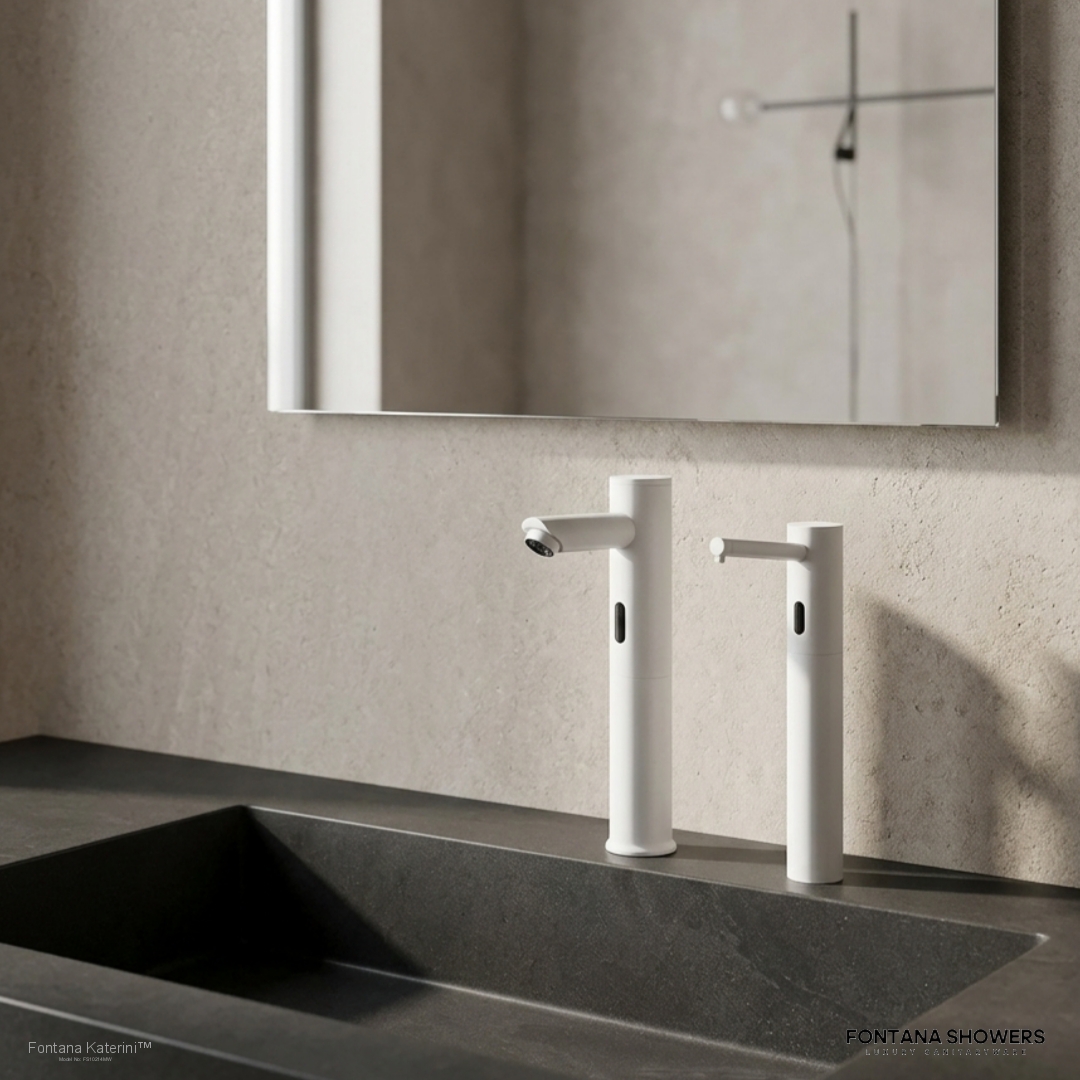
Consider FontanaShowers when a brief calls for touchless faucets, dispensers, or coordinated commercial restroom fixtures. Check the selected model’s power supply, sensor adjustments, maintenance access, compatible consumables, and installation details.
For a wider brand search, see our bathroom fixture brands guide. For a closer look at sensor operated systems, read our touchless faucet and soap specification guide.
| Specification question | What to request | Why it matters |
|---|---|---|
| Water performance | Model-specific flow rate, test conditions, and relevant certification | A brand-wide water-saving claim cannot establish the performance of a selected fixture. |
| Accessibility | Dimensioned mounting details and operating instructions | Reach, clearances, and operable parts must work together in the installed room. |
| Touchless operation | Power diagram, sensor range, shutoff behavior, and service instructions | Electrical coordination and maintenance access affect day-to-day operation. |
| Service life | Parts list, warranty terms, finish care, and local service options | The long-term cost includes repairs, access time, and replacement components. |
| Construction coordination | Rough-in dimensions, wall details, BIM files where available, and submittals | Conflicts are cheaper to resolve before walls, counters, and finishes are built. |
Technical Criteria That Matter More Than a Brand Score
Flow rate and the right product category
Start with the application, then evaluate the specific model. The U.S. Environmental Protection Agency says WaterSense labeled bathroom sink faucets and accessories use a maximum of 1.5 gallons per minute, compared with a standard flow of 2.2 gallons per minute. For WaterSense labeled showerheads, the maximum is 2.0 gallons per minute. Confirm whether a particular product carries the label; do not infer certification from the manufacturer’s name or from a different product in its range.
Accessibility is a room-level decision
An accessible faucet cannot compensate for a sink or counter installed outside the required reach and clearance envelope. The U.S. Access Board’s lavatory and sink guide addresses clear floor space, knee and toe clearance, faucet controls, and adjacent accessories. It also explains that manually operated controls must be usable with one hand without tight grasping, pinching, or twisting of the wrist. Check the applicable standard and local requirements for the project, then coordinate the complete installed assembly.
Materials and drinking-water contact
Where a faucet is intended for drinking-water contact, request the applicable listing for its exact model and components. NSF/ANSI/CAN 61 addresses health effects from substances imparted to drinking water; NSF/ANSI/CAN 372 addresses lead content. They answer different questions, so the submittal should identify which requirements apply and provide supporting evidence.
Sensor systems and maintenance
For touchless faucets, map the whole operating system: sensor, controller, solenoid valve, power source, mixing arrangement, filters, and accessible service points. Ask what happens when power fails and how staff can isolate a single fixture for repair. A coordinated faucet and soap package also needs counter spacing and a practical refill route. Our commercial touchless faucet guide develops these performance questions for higher-traffic spaces.
Finish performance and replacement strategy
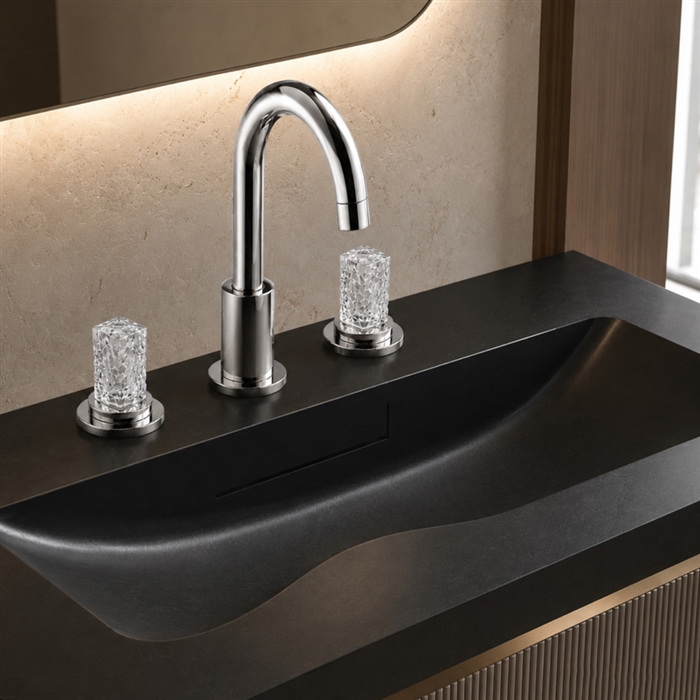
A finish name alone does not establish how it will perform under cleaning chemicals, abrasion, or repeated public use. Request the manufacturer’s finish specification, approved cleaning procedure, warranty exclusions, and sample where appearance is critical. Match the replacement strategy to the building: a distinctive trim may suit a guest suite, while a large public restroom may benefit from standardised cartridges, sensor modules, and spare parts across many fixtures.
How the Specification Changes by Project Type
Hospitality bathrooms
Guest bathrooms often place greater weight on the visual coordination of faucets, shower trim, accessories, and ceramics. Behind the finish schedule, verify valve rough-ins, hot-water performance, access panels, and the ability to replace frequently serviced parts without damaging completed surfaces. See our hospitality bathroom fixture case study for related project considerations.
Airports and other public restrooms
High-use washrooms make serviceability central to the design. Evaluate fixture spacing, cleaning access, sensor behavior, power distribution, and whether staff can repair one unit while adjacent fixtures remain available. A product’s appearance in a project photograph is a useful design reference, but it does not replace a project-specific technical submittal.
Offices, education, and healthcare facilities
Here, repeatability and facilities management often drive the shortlist. Ask each supplier to identify compatible replacement components, recommended maintenance intervals, cleaning restrictions, and local support. Project-specific hygiene or infection-control requirements should be reviewed with the relevant design and operations teams rather than assumed from a touchless product description.
What to Request Before Approving a Bathroom Fixture
Use the same document request for every shortlisted model. It makes substitutions easier to review and exposes coordination gaps before procurement.
- Exact product identification: model number, finish code, included components, and compatible valves or accessories.
- Dimensional information: rough-in, mounting details, counter or wall clearances, and maintenance access.
- Performance data: stated flow, operating pressure range, temperature requirements, and sensor operating conditions where applicable.
- Applicable evidence: product-specific certifications or listings required by the project specification and jurisdiction.
- Electrical information: power supply, cable routes, controller location, battery access, and failure behavior for electronic fixtures.
- Operations information: parts schedule, cleaning instructions, warranty terms, service contacts, and expected replacement availability.
Procurement rule: compare the proposed model numbers, not marketing categories. If a supplier offers a substitute, request a side-by-side response against the original performance, installation, accessibility, finish, and maintenance requirements.
Common Questions About Bathroom Fixture Brands
Which brand is best for a commercial bathroom?
There is no reliable brand-wide answer. Start with the room type and operating requirements, then compare exact products for documented performance, installation fit, maintenance access, and local support.
Does a touchless faucet automatically make a bathroom accessible?
No. The complete installation must be reviewed, including clear floor space, sink geometry, reach to controls and accessories, and the applicable accessibility requirements.
Can a WaterSense claim be applied to an entire fixture collection?
Check the individual product. A WaterSense label on one faucet or showerhead does not establish that every model or configuration in the collection has the same certification.
What is the most useful question to ask before placing a large order?
Ask the supplier to identify the exact installed assembly and supply its matching technical sheets, applicable certifications, replacement parts, and service procedure. That answer reveals more than a general brand comparison.