
Bathroom Fixture Brands: An Architect’s Review of 25 Options
A useful brand shortlist begins with the building’s requirements. This guide examines 25 manufacturers and suppliers across faucets, showers, sanitaryware, and commercial washrooms, then shows how to test each proposed product against accessibility, water use, documentation, maintenance, and procurement needs.

How architects should compare bathroom fixture brands
A brand can offer an extensive catalog while individual products differ substantially in flow rate, rough-in geometry, accessibility, finish construction, replacement parts, and required maintenance. Specification therefore belongs at the model and configuration level. A manufacturer name establishes a possible source; the selected product’s current submittal establishes what can actually be reviewed.
This collection is unranked. It does not assign unsupported scores, imply that named architectural firms endorse the brands, or treat online review searches as product-performance evidence. The purpose is to help project teams build a shortlist and request comparable documentation. Architectural Daily’s touchless faucet and soap-system specification guide offers a closer examination of one commercial fixture category.
Compare the proposed assembly
Record the exact faucet, valve, sensor, controller, aerator, finish, power supply, and replacement components. A product-family brochure is not a complete submittal.
Compare the delivery plan
Confirm regional availability, approved alternates, spare parts, warranty scope, installation documents, and the effect of substitution on the design.
Build the technical comparison before selecting a brand
The U.S. Access Board’s lavatory guidance helps teams evaluate accessibility in covered facilities. EPA WaterSense specifications apply to defined product categories and qualifying models; a brand’s participation does not mean every fixture carries the label. For drinking-water contact components, NSF/ANSI/CAN 372 addresses lead-content verification. Match each document to the selected product and the project’s jurisdiction.
| Review area | Request from supplier | Why it changes the specification |
|---|---|---|
| Hydraulic performance | Rated flow, test pressure, valve data, mixing requirements, and applicable certifications | Determines water delivery, basin behavior, efficiency claims, and compatibility with the supply system. |
| Accessibility | Installation dimensions, reach to controls, clearances, and the selected basin or shower layout | Compliance depends on the installed room and assembly, not the fixture photograph. |
| Finish and materials | Substrate, coating process, cleaning instructions, and finish-specific warranty | Identically named finishes can differ in construction and maintenance needs. |
| Touchless controls | Sensor range, power architecture, shutoff logic, valve access, and commissioning method | Determines false activation risk, service time, and the handwashing experience. |
| Documentation | Current cut sheet, installation manual, listing for the exact model, and BIM object where available | Reduces unresolved coordination issues and inaccurate substitutions. |
| Lifecycle support | Spare-part list, service procedure, lead time, warranty exclusions, and regional support | Affects downtime and ownership cost after construction. |
A certification belongs to a model, not a logo
Do not label an entire brand “ADA compliant,” “WaterSense certified,” or “NSF listed.” Check the installed layout for accessibility and verify each applicable product listing or label against the exact model and configuration.
Bathroom fixture brands by specification use
The cards identify a practical starting category for each brand and one question to put to its representative. They are not performance rankings. Product availability and documentation can vary by country, collection, and model.
KOHLER
Consider for projects coordinating faucets, showers, bathing products, and sanitaryware within one design vocabulary.
Ask: Which selected finishes and service parts are available across the entire project schedule?
View official site ↗GROHE
Review its faucet and shower ranges where a project needs consistent controls and visible finish coordination.
Ask: Are the proposed valve, trim, and finish combinations supported in the project’s region?
View official site ↗FontanaShowers
Evaluate specific touchless faucet, dispenser, and shower configurations against project drawings and service requirements.
Ask: Which exact assembly has the needed sensor, power, flow, finish, and current listing documentation?
View official site ↗TOTO
Include where the toilet system and associated electrical, water, and maintenance interfaces need close coordination.
Ask: What rough-in, supply, power, and service access does the selected fixture require?
View official site ↗hansgrohe
Compare shower controls and outlets as an installed system, including valve compatibility and replacement access.
Ask: Are the specified outlets, valve, and trim documented as one compatible configuration?
View official site ↗Delta Faucet
Consider where a project needs multiple fixture types and coordinated replacement-part planning.
Ask: Which cartridges and service parts are common across the proposed models?
View official site ↗Moen
Assess the chosen faucet and shower collections by installed dimensions, valve architecture, and finish availability.
Ask: What are the finish-specific cleaning and warranty requirements?
View official site ↗American Standard
Useful to review when coordinating toilets, sinks, and fittings across repeated room types.
Ask: Do the selected bowl, flush device, and accessible-room details align as installed?
View official site ↗Sloan
Evaluate flushometers, sensor faucets, and related washroom equipment as a coordinated maintenance program.
Ask: How are valve access, power, sensor adjustment, and spare parts documented?
View official site ↗Zurn
Consider the relationship between specified fixtures, flush devices, drainage, and building plumbing infrastructure.
Ask: Are the selected components compatible at the actual supply and drainage conditions?
View official site ↗Bradley
Review wash stations and institutional fixtures where simultaneous use, cleaning, and maintenance access matter.
Ask: What fixture clearance and service space are needed at peak occupancy?
View official site ↗Bobrick
Coordinate dispensers, accessories, partitions, and accessible mounting positions with the room layout.
Ask: Can consumables be refilled and components serviced without obstructing circulation?
View official site ↗Elkay
Review sink geometry and surrounding casework alongside the selected faucet and accessible approach.
Ask: Where does the water stream strike the actual basin at the rated flow?
View official site ↗Duravit
Assess the relationship between sanitaryware dimensions, furniture, concealed services, and maintenance access.
Ask: What wall support and access are required for the exact installation?
View official site ↗Roca
Consider multi-category bathroom coordination, including local product availability and regional specifications.
Ask: Are the selected models and replacement components available in the project’s market?
View official site ↗Geberit
Pay particular attention to concealed installation depth, structural support, access panels, and replacement parts.
Ask: Can every serviceable component be reached after the wall finish is complete?
View official site ↗Villeroy & Boch
Compare sanitaryware shapes and finishes with the project’s cleaning methods and replacement strategy.
Ask: Are the exact ceramic and seat configurations documented for procurement?
View official site ↗Ideal Standard
Evaluate fixture families at the model level, especially when multiple room types must share service parts.
Ask: Which technical documents apply to the selected regional product line?
View official site ↗Dornbracht
Review the concealed and exposed parts together where precise architectural detailing drives fixture placement.
Ask: What rough-in tolerances and service access are required behind the finish?
View official site ↗AXOR
Assess visible trim and hidden valve components as one system rather than specifying by finish image alone.
Ask: Are the chosen finishes and controls available for all coordinated outlets?
View official site ↗Brizo
Compare the design intent with valve compatibility, installed dimensions, and finish-specific care.
Ask: Which concealed components must be ordered with the visible trim?
View official site ↗KALLISTA
Review finish coordination and the complete bill of materials for projects with highly detailed interiors.
Ask: What are the lead times and replacement options for the selected finish?
View official site ↗Waterworks
Assess fittings with the project’s basin, stone, wall construction, and maintenance expectations.
Ask: Are rough-in, finish care, and service requirements coordinated with the interior drawings?
View official site ↗BathSelect
Review specific sensor faucet and shower assemblies for sensing behavior, water delivery, power, and installation access.
Ask: Does the exact selected model have the drawings and documentation required for this project?
View official site ↗Jacuzzi
Consider the structural, electrical, drainage, cleaning, and service implications of the selected bathing system.
Ask: What access is needed to maintain pumps and other serviceable equipment?
View official site ↗Move from a brand shortlist to a coordinated bathroom
The room is the unit that occupants experience. A faucet needs the right basin depth and water impact point; a shower needs compatible controls, drainage, and service access; a toilet needs the correct rough-in and clearance. The accessible lavatory requirements are assessed in the installed environment, not by treating a faucet as independently “ADA certified.”

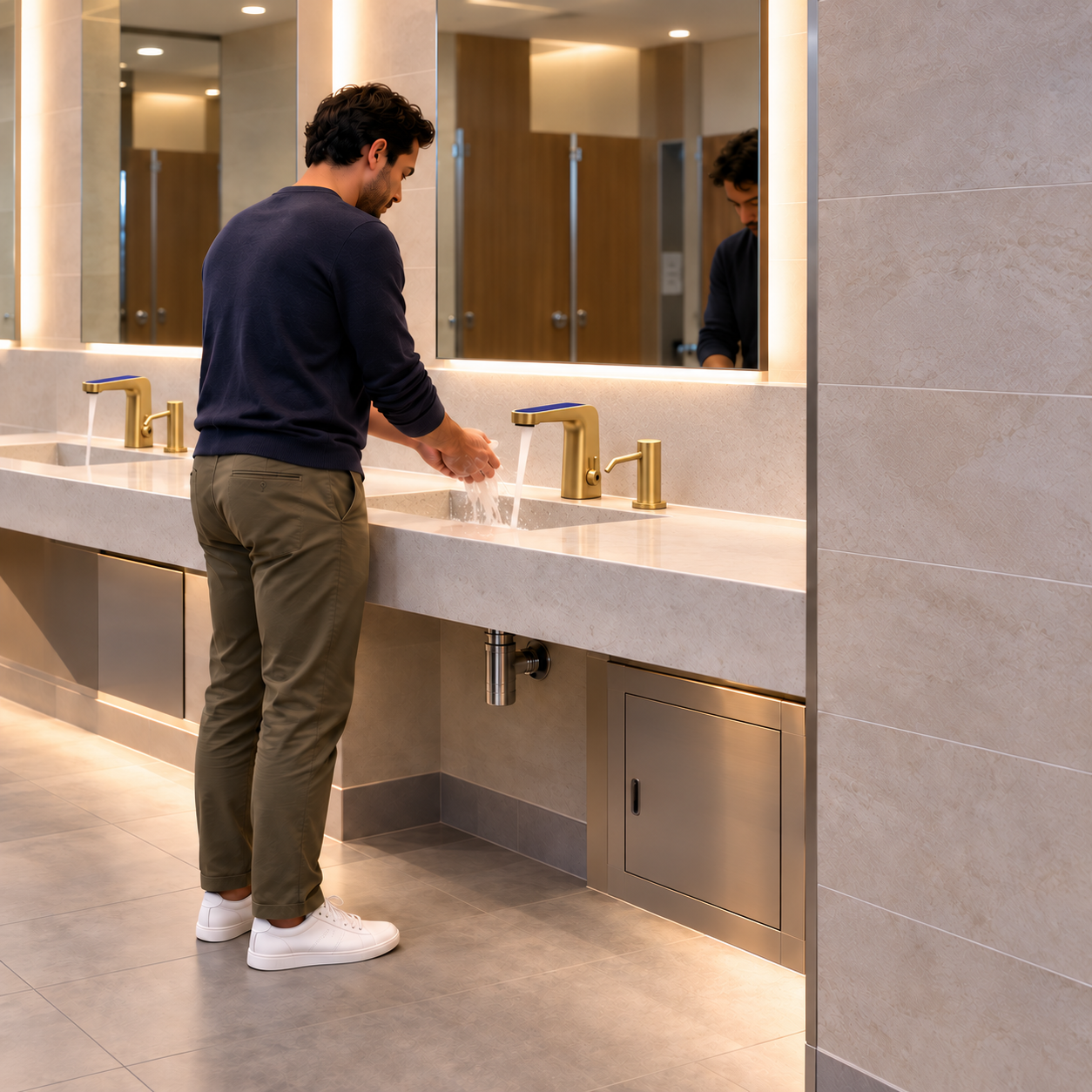
For higher-use environments, Architectural Daily’s hospitality bathroom fixture case study illustrates why guest experience must be considered alongside repeated maintenance. Its commercial touchless faucet technology guide develops the sensing and service questions that a brand list cannot answer.
Model ownership cost with project data
Total cost of ownership depends on more than the purchase price. For each shortlisted assembly, estimate initial cost, installation labor, consumables, scheduled maintenance, replacement parts, likely service disruptions, and availability over the intended operating period. Do not assign a numerical durability or maintenance score unless the evidence and calculation method are published.
Procurement decision rule
Approve the complete, documented assembly that meets the project’s performance and operational requirements. Use the brand name to find candidates; use submittals, listings, installation details, and service evidence to select one.
Technical questions before approving a substitution
Does the alternative preserve the approved layout? Compare spout reach, basin splash behavior, accessible clearances, shower valve location, rough-in dimensions, and service access. A similar appearance does not establish dimensional equivalence.
Do efficiency and material claims apply to the exact replacement? Check the relevant EPA WaterSense product category and the model’s actual label status. For drinking-water components where applicable, review the exact product’s lead-content documentation and other specified listings.
Can facilities maintain it? Obtain replacement-part identifiers, access procedures, warranty exclusions, cleaning instructions, and local availability. The answer may change when a project uses dozens or hundreds of identical rooms.