

Touchless Faucet Standards & Submittal Review
A touchless faucet submittal must connect the selected sensor-operated faucet to its applicable standards, certified configuration and installation requirements. Review the evidence for water-contact materials, flow performance, temperature control and accessible operation before accepting the proposed model.
This guide addresses U.S. commercial lavatory applications. Establish the adopted plumbing code, referenced standard editions and project specification before determining which requirements apply.
Which standards apply to touchless faucets?
Sensor activation is one feature of the faucet. The review also addresses supply-fitting conformity, potable-water contact, outlet flow, temperature-limiting equipment and the completed lavatory installation. Each requirement needs its own supporting evidence.
ASME A112.18.1 / CSA B125.1
This standard covers plumbing supply fittings, including lavatory fittings and metering or self-closing fittings. Identify the edition referenced by the project and the compliance evidence required for the submitted faucet.
Submittal review: Match the manufacturer, model designation and supplied configuration to the listing or other conformity documentation accepted by the project. Keep the standard edition visible in the review record.
NSF/ANSI/CAN 61
NSF 61 evaluates the health effects of materials and components that contact drinking water. Its evidence addresses the water-contact product within the certification scope.
Submittal review: Verify the exact faucet model in the certifier’s current record. Identify any separately supplied wetted valves, hoses or mixing devices and obtain the required evidence for those components. Retain listing restrictions relevant to the intended service.
NSF/ANSI/CAN 372
NSF 372 evaluates lead content. EPA’s lead-free definition for covered plumbing fittings and fixtures permits a maximum weighted average of 0.25% lead across wetted surfaces. Lead-content evidence and health-effects evidence address different requirements.
Submittal review: Check the applicable lead-free certification, covered model and certification mark. A general statement such as “brass construction” does not establish compliance.
NSF: Standard 372 requirements · EPA: Lead-free plumbing requirements
ASSE 1070 temperature limiting
ASSE 1070 / ASME A112.1070 / CSA B125.70 covers water temperature-limiting devices used to reduce scald risk at fixtures including lavatories. Its scope excludes thermal-shock protection.
Submittal review: Identify the actual limiting device, whether integral or separate. Check its listing, supply conditions, minimum operating flow and adjustment instructions against the proposed faucet and piping arrangement. A mixing connection alone does not establish the required temperature-limiting performance.
EPA guidance and WaterSense scope
EPA identifies 0.5 gpm or less as the efficient flow range for public lavatory faucets. Its current WaterSense labeling criteria cover private lavatory and bar sink faucets; public lavatory and metering faucets are outside that labeling scope.
Submittal review: Classify the fixture use, apply the adopted code and project flow limit, and verify the outlet insert and rated test pressure. Review a WaterSense label only for an eligible product type.
ADA Standards: Lavatories and controls
Evaluate the faucet together with the basin, counter, approach space, controls and protected plumbing. The U.S. Access Board distinguishes motion-activated faucets from manually operated metering controls: touch-free controls have no minimum activation-duration requirement.
Submittal review: Coordinate required reach and knee/toe clearances. Any manual temperature control must satisfy applicable operable-part requirements. Place controllers, valves and protective enclosures outside the required clearance envelope.
Review the faucet in its proposed basin arrangement
Use the manufacturer’s dimensional and installation drawings to resolve mounting, sensor coverage and service access before the fixture is ordered.
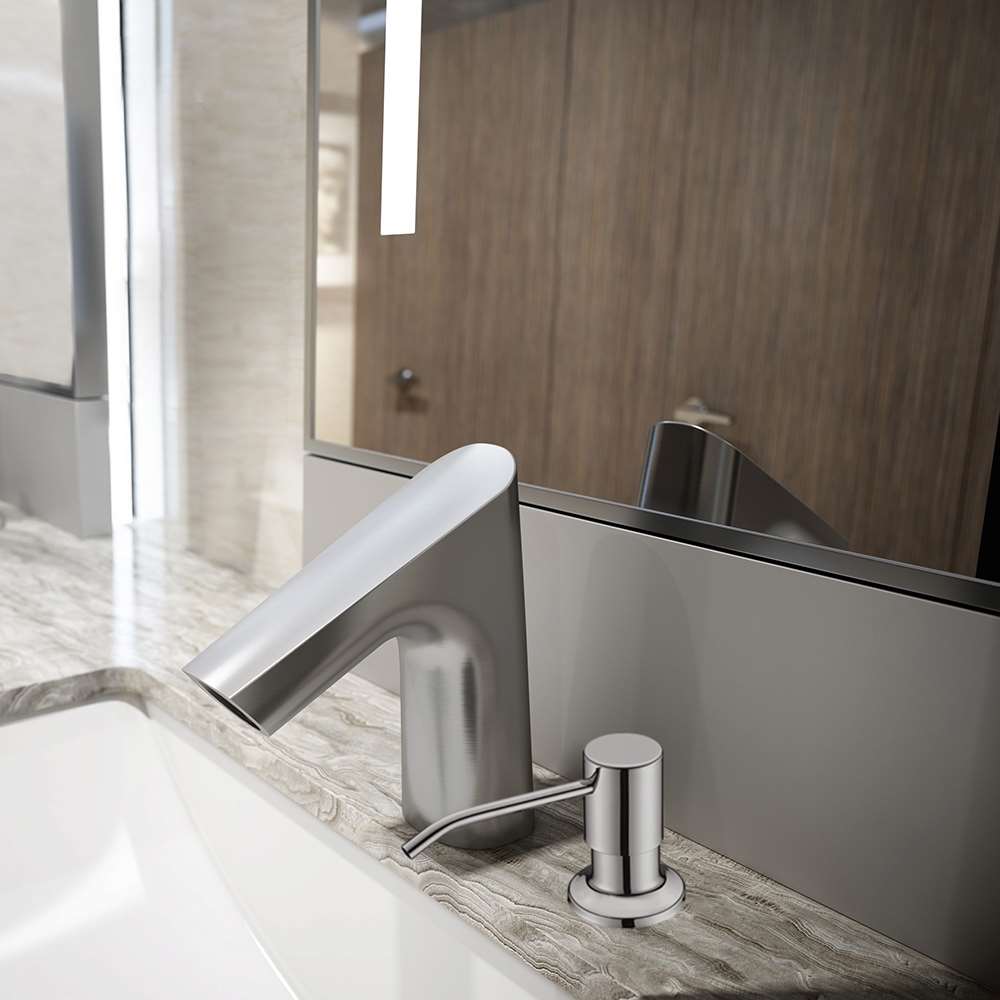
Deck-mounted faucets
Confirm mounting-hole diameter, allowable deck thickness, spout reach and access to the retaining hardware. Locate the outlet over the basin using the coordinated detail.
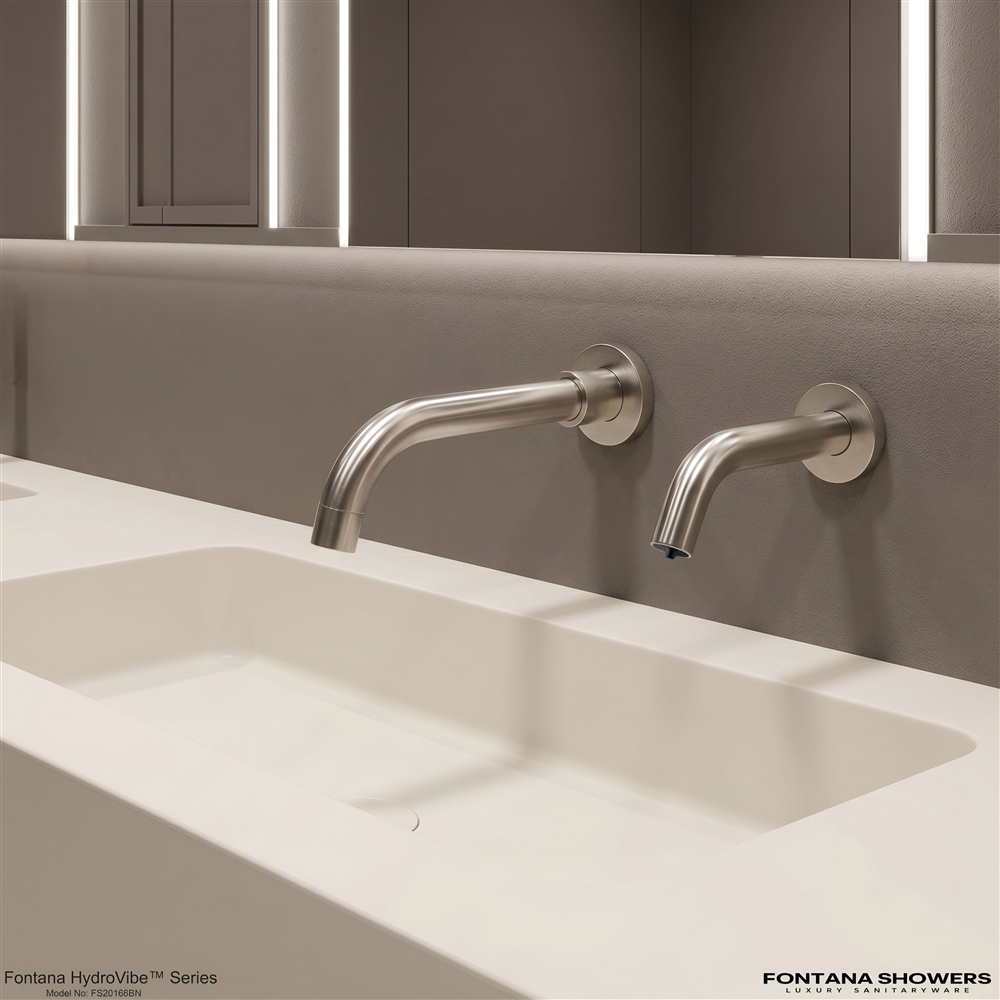
Wall-mounted faucets
Coordinate finished-wall thickness, outlet projection and concealed rough-in position. Show how the sensor, valve and connections can be serviced after the wall finish is complete.
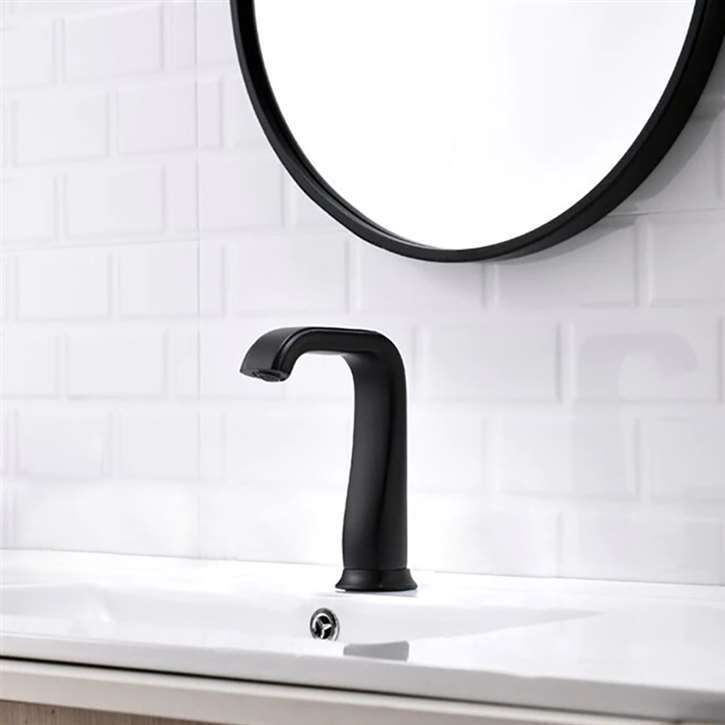
Sensor-to-basin alignment
Check the documented sensing zone against the bowl, backsplash and handwashing position. Confirm the manufacturer’s calibration procedure and assess reflections or obstructions during the installed functional test.
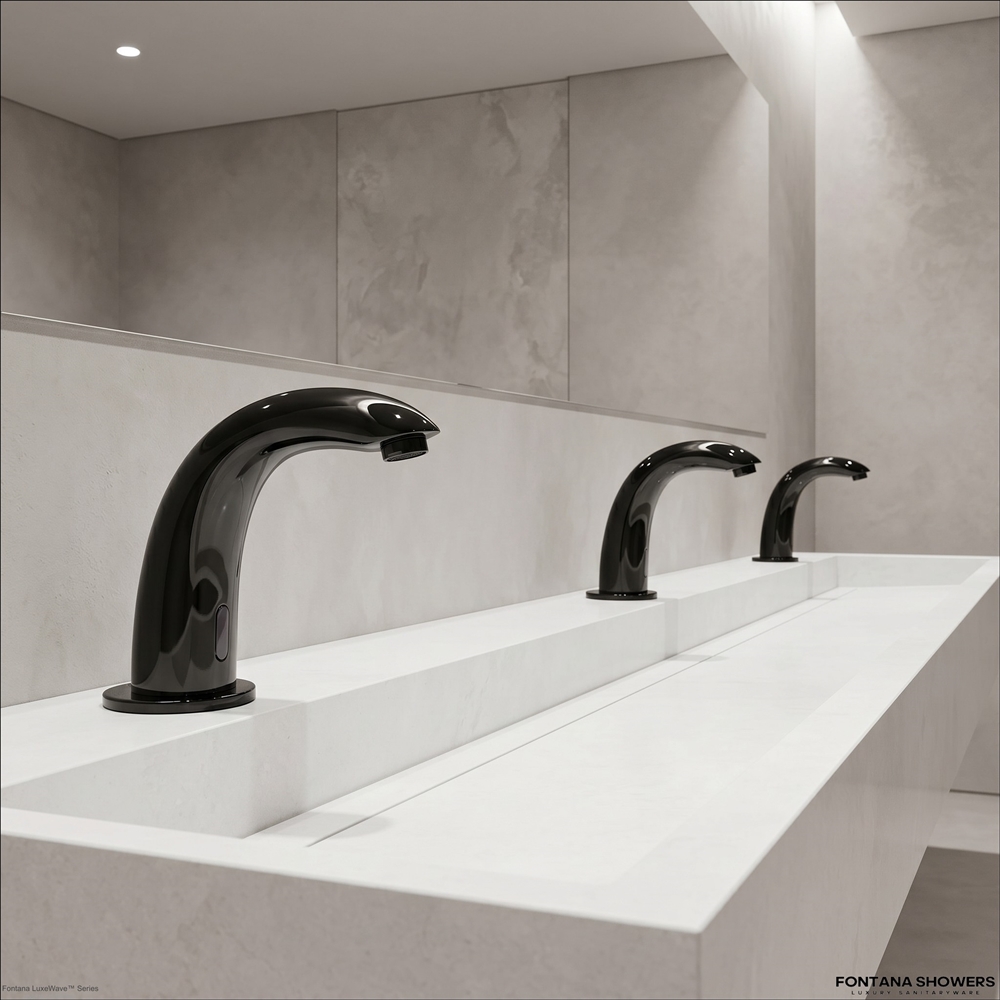
Multiple sensor stations
Identify each faucet’s controller and water connection. Coordinate power distribution, isolation and service access, then test adjacent stations for unintended activation in the completed arrangement.
Installation imagery: FontanaShowers. Images illustrate mounting arrangements; certification must be verified for the submitted model.
What a touchless faucet submittal should contain
The package should identify one purchase-ready configuration and provide the documents needed to assess it. Mark the selected options wherever a cut sheet presents several models or configurations.
Cut sheet and certification records
- Complete model number, finish, mounting type, power option and included accessories.
- Applicable supply-fitting, health-effects and lead-content conformity records.
- Separate documentation for the temperature-limiting device and other specified components.
Flow, sensor and power data
- Outlet insert identifier, rated flow, reference pressure and allowable operating pressure range.
- Detection settings, shutoff delay, maximum run time and documented behavior during power loss.
- Battery or power-supply model, electrical ratings, wiring requirements and applicable equipment approvals.
Installation and service information
- Dimensioned faucet-to-basin arrangement, mounting detail and coordinated supply connections.
- Locations for the controller, solenoid, strainer, stops and temperature-limiting device.
- Access requirements, adjustment procedure, maintenance instructions and replacement-part identification.
When a submittal needs revision
Write each review comment around the unresolved requirement, the affected component and the evidence needed to close the issue.
The model cannot be matched
Request a marked cut sheet and certification record that reconcile the proposed designation, selected options and accessories. Resolve differences between the purchase description and supporting documents.
Performance conditions are missing
Request the flow-test pressure, outlet configuration and operating limits. Where a temperature-limiting device is required, verify compatibility at the intended faucet flow and supply conditions.
The installation is unresolved
Request a coordinated detail showing basin geometry, sensing position, equipment locations and service access. Resolve any conflict with required accessible clearances before installation.
Record the reviewed model, source documents and final disposition together. Carry the accepted configuration into procurement and installation, then verify sensor activation, shutoff, outlet flow, temperature and leakage against the approved project criteria.
For lead-free mark verification, use EPA’s certification-mark guidance. Related technical reading: commercial restroom specification resources .
Commercial Bathroom Faucets — Standards, Compliance and Technical Submittal Coordination
Selecting commercial bathroom faucets requires more than comparing finishes and appearance. Architects, engineers and contractors must examine plumbing connections, sensor technology, operating pressure, installation dimensions, electrical requirements, material construction, and applicable accessibility standards. The following FontanaShowers faucets illustrate important considerations for technical submittal evaluation and coordinated architectural specification.

Fontana Chrome Automatic Sensor Bathroom Faucet
Sensor Operation and Accessibility Coordination
The Fontana Chrome Automatic Sensor Faucet provides a hands-free water delivery solution for commercial washrooms. From a technical submittal perspective, the design team should assess the sensor activation zone, basin compatibility, plumbing connections and control-system requirements. Accessibility evaluation should also consider the complete installed lavatory assembly rather than the faucet alone, ensuring that clearances and reach conditions are appropriate for the intended project.View Live Faucet →

Fontana Commercial Automatic Sensor Faucet in Chrome
Adjustable Detection for Engineering Evaluation
This commercial faucet demonstrates the value of properly coordinating automatic sensing with basin geometry. During submittal evaluation, the architect and plumbing engineer should confirm the sensing distance, deck opening, under-counter component access, electrical routing and supply-line arrangement. Checking these details against the actual lavatory specification can reduce unwanted sensor activation and simplify the installation process.View Live Faucet →

Fontana Commercial Brushed Nickel Automatic Sensor Faucet
Practical Finish and Fixture Documentation
The brushed-nickel finish provides a restrained architectural appearance suitable for office buildings, hospitality facilities and commercial washrooms. During product approval, the specification team should establish the exact finish, faucet mounting conditions, sensing configuration and power requirements. The project documents should also identify the selected faucet configuration clearly so that installers and maintenance personnel can coordinate the correct components.View Live Faucet →

Fontana Halo AquaSense Rose Gold Wall Mounted Sensor Faucet
Wall-Mount Coordination and Finish Approval
The Fontana Halo AquaSense faucet combines wall-mounted installation with automatic infrared activation and a distinctive rose-gold finish. This configuration makes detailed coordination particularly important. The design team should confirm wall thickness, mounting height, spout projection, basin alignment and concealed plumbing requirements before approving the submittal. Finish samples should also be evaluated against the surrounding interior materials to maintain consistency throughout the bathroom.View Live Faucet →

Fontana Commercial Grade Polished Gold Automatic Sensor Faucet
Technical Documentation for Premium Commercial Projects
This polished-gold automatic faucet offers a visually distinctive option for commercial restrooms where luxury finishes are part of the architectural design. Its manufacturer listing identifies several technical resources, including BIM files, specification sheets, installation instructions and maintenance guidance. During submittal approval, the design team should confirm the correct faucet configuration, mounting arrangement, water-delivery characteristics and compatibility with the project's electrical and plumbing infrastructure.View Live Faucet →

Fontana Oil Rubbed Bronze Commercial Automatic Sensor Faucet
Commercial Reliability and Documentation Planning
The Fontana oil-rubbed bronze automatic faucet illustrates how traditional finish selections can be combined with contemporary hands-free technology. Its commercial application makes proper submittal documentation essential, including the selected faucet model, power supply, sensing configuration, plumbing requirements and maintenance procedures. The manufacturer's technical-resource links provide a starting point for engineering coordination, while project-specific code compliance must be established before final approval.View Live Faucet →