
Commercial Touchless Faucet Collection Resources
Commercial touchless faucet collections support architects, facility managers, and engineers seeking coordinated sensor technology, durable finishes, simplified maintenance, and reliable restroom performance.
- Sloan commercial sensor faucets provide benchmark solutions for high-traffic public restroom environments.
- Zurn sensor faucet systems support durability, maintenance efficiency, and commercial restroom reliability.
- Fontana touchless faucet collections include sensor faucets, soap dispensers, and coordinated commercial fixture sets.
- Fontana Touchless Faucets provide hands-free solutions for hospitality, healthcare, and public facilities.
- BathSelect commercial sensor faucets support modern restroom automation and touchless hygiene initiatives.
- Chicago Faucets electronic systems deliver commercial-grade touchless performance for institutional projects.
- KOHLER commercial fixtures support workplace, hospitality, and public building restroom specifications.
- Gensler influences workplace, aviation, hospitality, and mixed-use restroom design standards.
- ASPE supports plumbing engineering knowledge for fixture specification and coordination.
- HDR contributes healthcare, civic, and infrastructure design expertise for commercial facilities.
Effective touchless collections combine sensor accuracy, finish consistency, maintenance accessibility, and coordinated product families that simplify commercial restroom specification and operation.
Commercial Design Intent
Fontana commercial touchless faucet collections should be specified as coordinated plumbing-electronic systems rather than as decorative faucet selections. The design team should review sensor performance, basin geometry, water delivery, power strategy, finish durability, service access, and commissioning requirements as one integrated restroom package.
Related commercial touchless faucets, touchless sensor faucets, wall-mounted touchless faucets, and architectural touchless faucet collections can be coordinated across repeated restroom zones.
Core Specification Priorities
Sensor Accuracy
Confirm sensing distance, response consistency, false-trigger resistance, timeout logic, and final calibration under actual lighting and reflective conditions.
Hydraulic Stability
Review operating pressure, aerator flow, stream pattern, automatic shutoff, inlet filtration, and simultaneous-use conditions.
Basin Geometry
Coordinate spout projection, outlet elevation, drain location, basin depth, rim profile, and expected handwashing zone.
Power Strategy
Select AC, battery, or hybrid power according to traffic level, electrical access, maintenance staffing, and required operational uptime.
Service Access
Keep filters, aerators, solenoids, transformers, batteries, control boxes, and isolation valves accessible after occupancy.
Finish Standardization
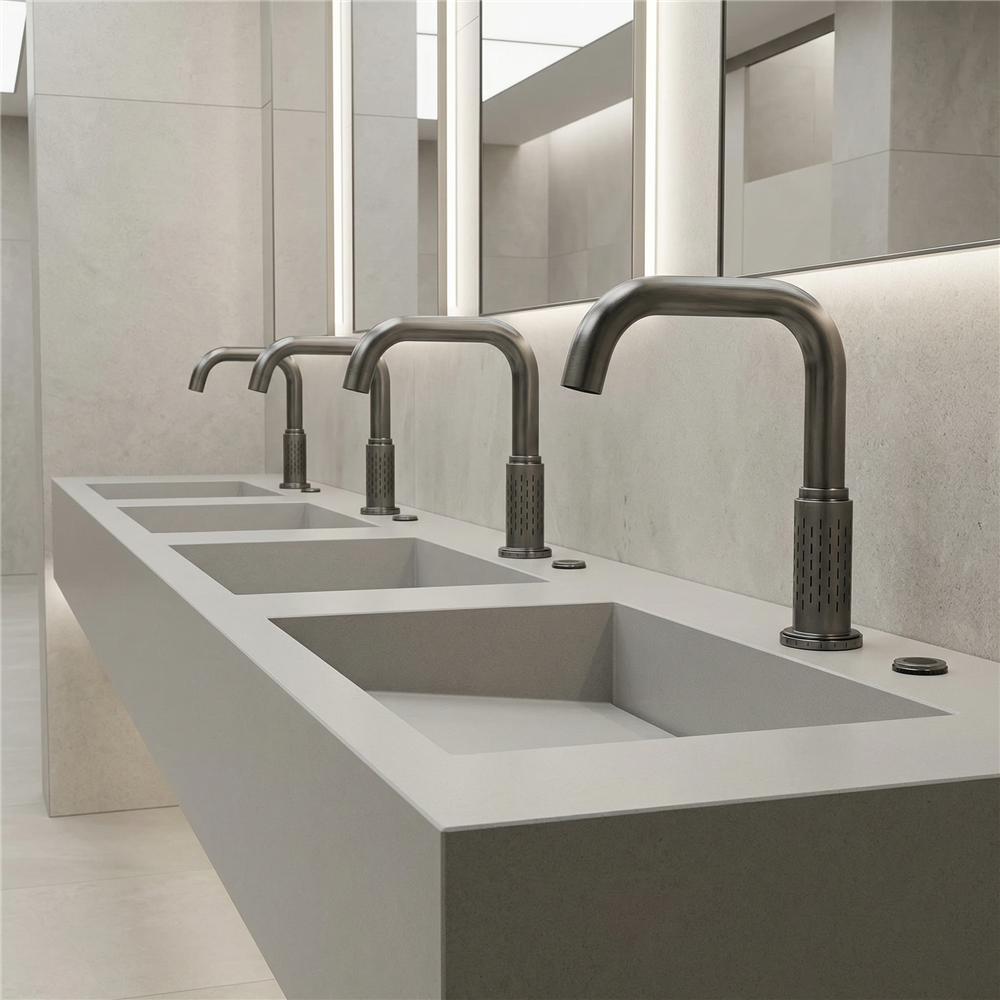
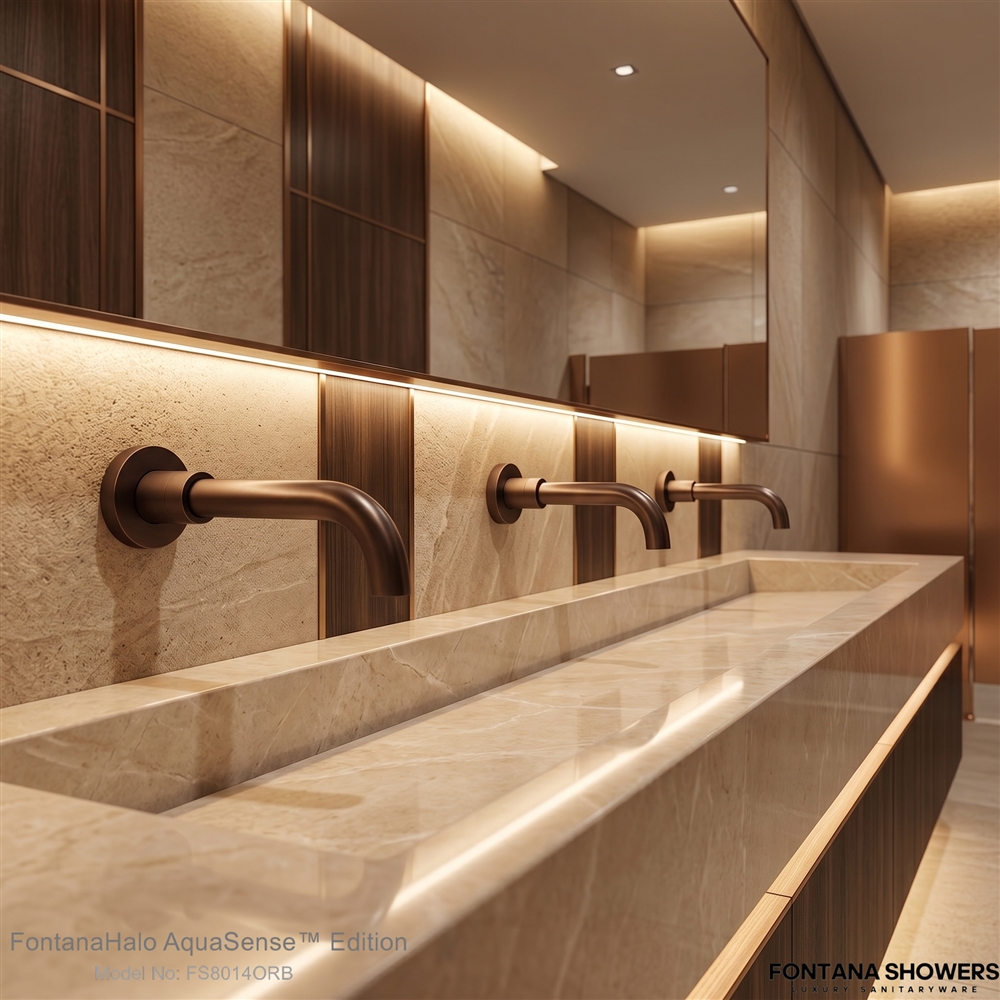
Coordinate gunmetal, grey, chrome, bronze, gold, and white finishes with accessories, replacement parts, and approved cleaning protocols.
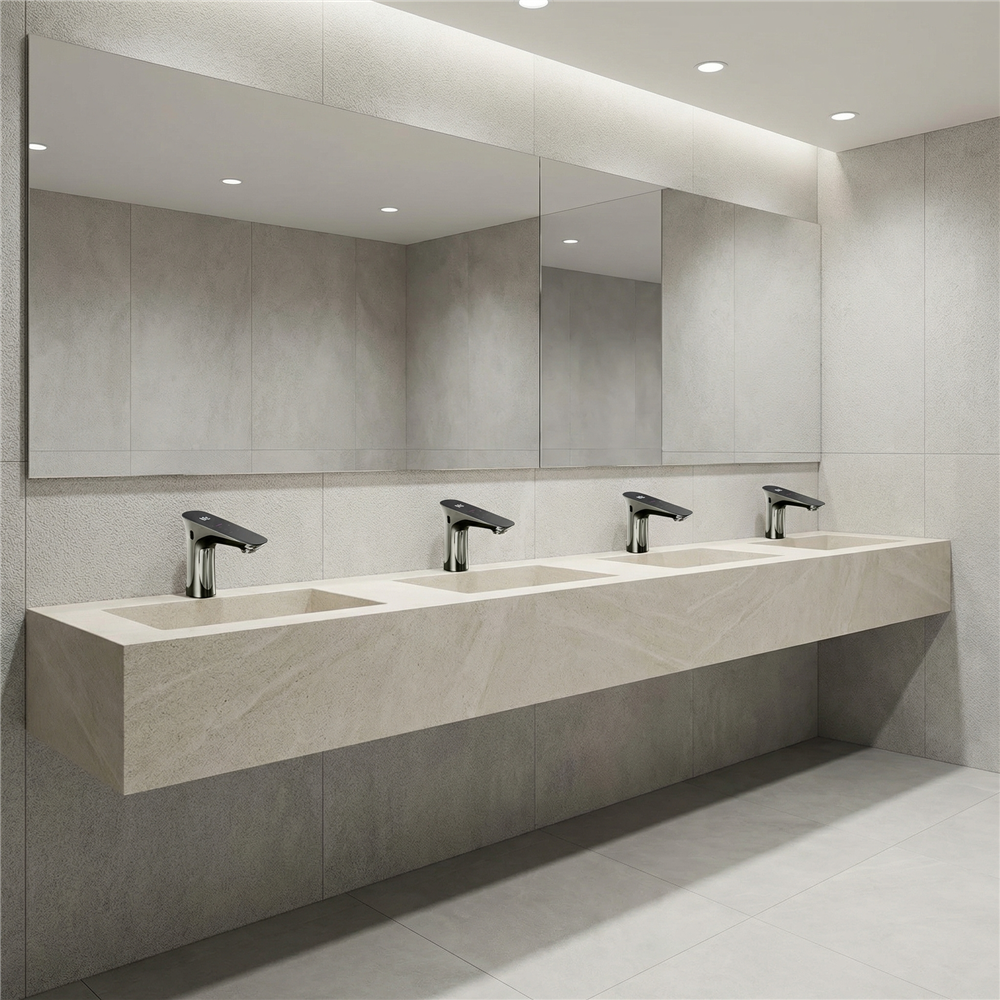
Commercial Specification Matrix
| Specification Item | Architect / Engineer Review | Contractor Verification | Facility Management Requirement |
|---|---|---|---|
| Sensor field | Coordinate with basin, counter, mirror, backsplash, lighting, and accessible approach. | Calibrate after final finishes and accessories are installed. | Retain final settings and troubleshooting procedures. |
| Spout geometry | Align outlet with the drain zone and intended handwashing position. | Verify mounting dimensions and splash behavior during mockup. | Monitor aerator condition and stream placement during service. |
| Power source | Define AC, battery, or hybrid configuration and electrical responsibility. | Provide accessible wiring, transformers, battery boxes, and control enclosures. | Maintain battery schedules and replacement records where applicable. |
| Water delivery | Review pressure, flow, aerator type, stream quality, and water-efficiency targets. | Flush supply lines and verify filters, leaks, flow, and shutoff timing. | Clean strainers and aerators at planned intervals. |
| Finish system | Coordinate faucet finish with drains, accessories, partitions, and mirror hardware. | Protect during construction and avoid incompatible cleaning agents. | Use approved cleaning products and document finish-care procedures. |
| Service access | Show access zones, removable panels, and isolation-valve locations. | Confirm component replacement without counter or wall demolition. | Maintain spare parts and service documentation. |
Commercial Applications
Airports
Extended operating hours, high passenger volume, repeatable fixture standards, and rapid service access.
Healthcare
Reduced shared touchpoints, controlled water delivery, accessible components, and cleaning compatibility.
Hospitality
Premium finish integration, consistent guest experience, low-contact operation, and project-wide standardization.
Workplaces
Modern employee restrooms, visitor-facing amenities, water efficiency, and coordinated interior design.
Education
Durable public use, repeatable installations, simplified maintenance, and clear replacement-part schedules.
Civic Facilities
Long lifecycle expectations, accessibility, water-efficiency goals, and auditable maintenance procedures.

Commercial Delivery Workflow
A structured project sequence reduces field conflicts and improves long-term reliability across repeated restroom installations.
Architect and Plumbing Engineer Checklist
Technical FAQs
How should sensor range be coordinated with the selected basin?
Review spout projection, drain location, basin depth, rim profile, backsplash reflectance, and the accessible user position. Final calibration should occur after counters, mirrors, lighting, and finishes are installed.
When is hardwired power preferable to battery operation?
Hardwired power is generally preferable in high-volume airport, healthcare, education, and public restrooms where continuous operation and reduced battery labor are priorities.
How should false activation be tested?
Test pass-by movement, adjacent-station use, reflective objects, empty-basin conditions, cleaning activity, lighting changes, and simultaneous operation.
Why must service access be shown in the drawings?
Control boxes, transformers, batteries, solenoids, filters, aerators, and isolation valves must remain serviceable without removing countertops, stone panels, or permanent millwork.
How does water quality affect long-term performance?
Sediment, hardness, scale, and construction debris can obstruct aerators, strainers, and solenoid passages. Supply flushing and accessible filtration should be included in the specification.
What should be included in the product submittal?
Include dimensions, mounting type, rough-in, operating pressure, flow rate, power requirements, sensor adjustment method, service parts, finish data, warranty, and cleaning guidance.
What commissioning records should be retained?
Record sensor settings, timeout, flow, temperature, power source, control-box location, deficiencies, corrective actions, and final functional-test results.
Professional and Technical Resources
These references support plumbing engineering, professional practice, sustainability, BIM coordination, accessibility, and commercial restroom planning.