

Best ArchitecturalDaily for 2026 — Ultimate Guide
The defining architecture trends 2026 are moving away from isolated visual trends and toward integrated performance: decarbonization, adaptive reuse, resilience, connected building systems, material accountability and maintainable infrastructure.
Architects and engineers increasingly need to connect visual design decisions to measurable operating outcomes. Building envelopes affect energy, daylight and thermal comfort. Structural systems affect embodied carbon. Digital controls affect energy use, diagnostics and cybersecurity. Plumbing fixtures influence water use, accessibility, hygiene and facility operations.
This guide therefore begins with broad architecture trends 2026, then progressively moves into high-performance buildings, intelligent systems, smart commercial restrooms and finally touchless faucets from leading manufacturers including FontanaShowers, BathSelect, GROHE, TOTO, Sloan and KOHLER.
Architecture Trends 2026: Performance Becomes the Design Language
Buildings are increasingly evaluated by how efficiently they operate, how easily they adapt, how resiliently they respond to disruption and how maintainable their systems remain throughout the lifecycle.
That changes the architectural workflow. High-performance buildings require closer coordination between architecture, structure, MEP, landscape, digital systems and facility operations during the earliest design phases.
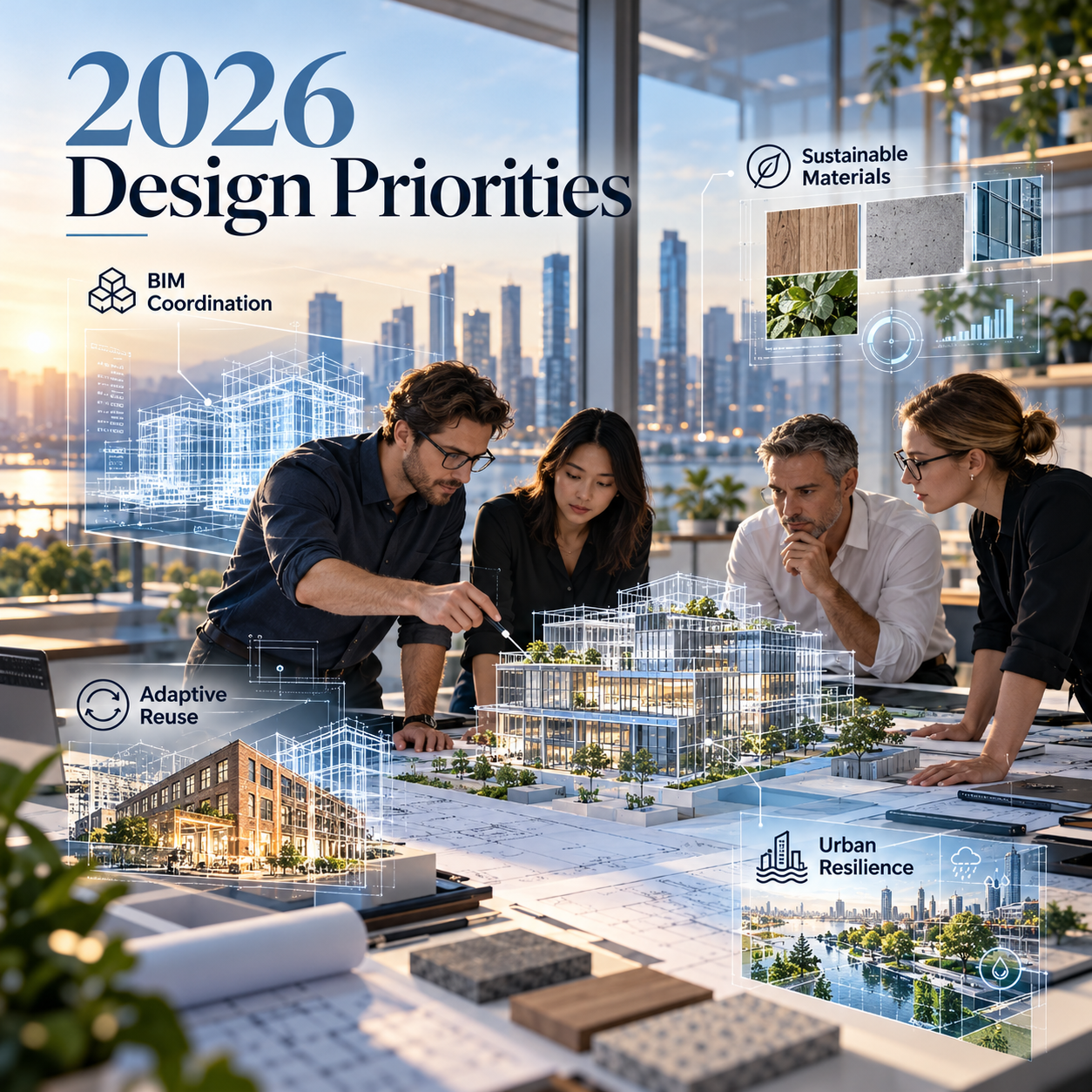
Performance Is Now an Architectural Input
BIM coordination, material strategy, adaptive reuse and climate resilience increasingly influence the architectural concept before detailed construction documents are developed.
Decisions about structural grids, facade depth, daylight access, equipment rooms and service zones determine how effectively other building systems can be integrated later.
This same logic applies at much smaller scales. A commercial touchless faucet appears simple, but its sensing zone, solenoid, power supply, mixing arrangement and service route directly affect the restroom architecture.
Architecture Focus Areas for 2026
The percentages below provide an editorial framework for this article. They organize the relative emphasis of the guide and are not presented as measured industry market-share statistics.
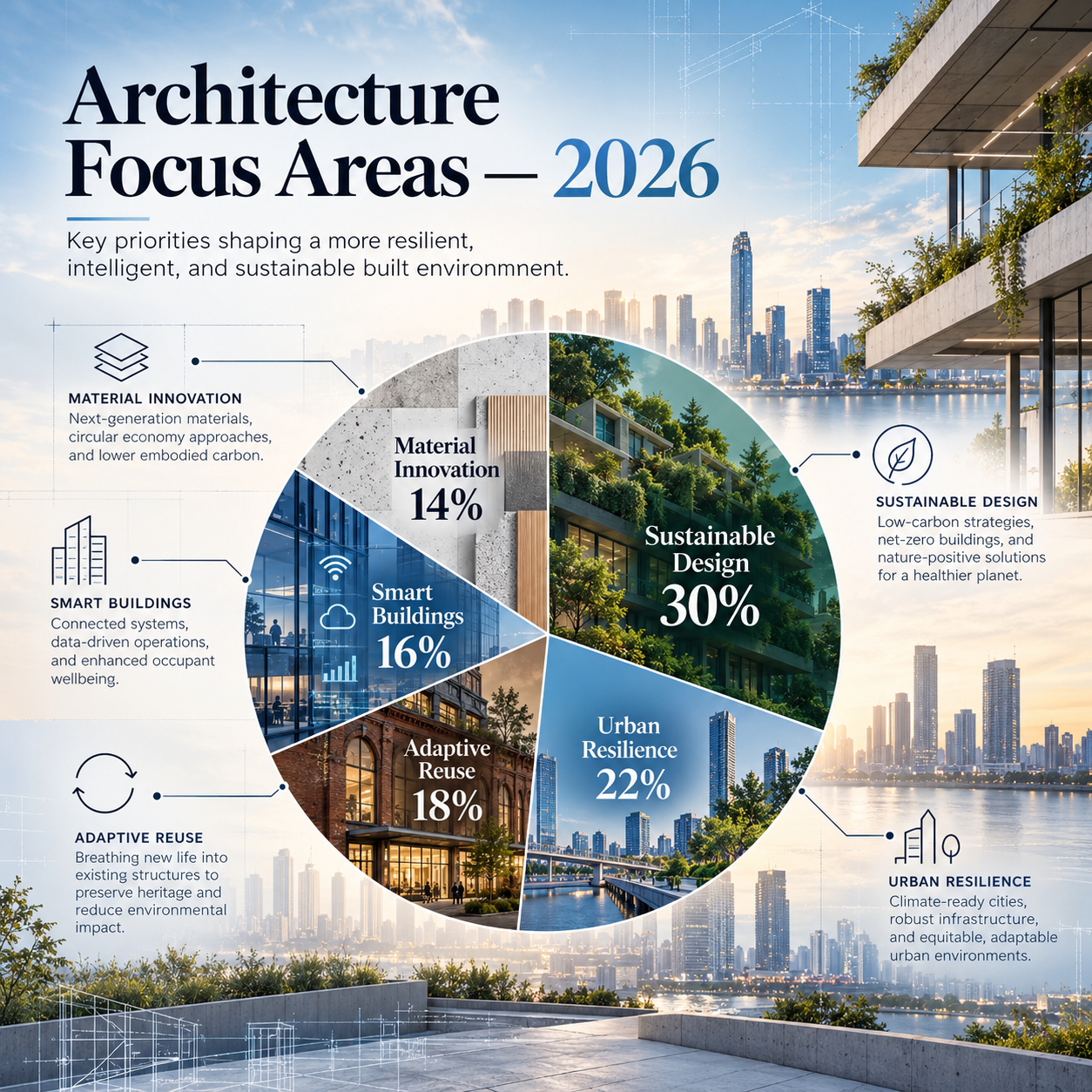
These themes increasingly overlap. A high-performance building needs efficient systems, resilient infrastructure, maintainable controls and products capable of supporting real operational goals.
That is why seemingly small elements such as automatic restroom faucets increasingly belong in the broader discussion of smart-building architecture.
Whole-Building Performance Replaces Isolated Green Features
Sustainable architecture in 2026 increasingly connects energy, carbon, water, material durability, accessibility and maintainability instead of evaluating individual products in isolation.
Energy + Carbon
Coordinate envelope, HVAC, electrification and operational controls.
- Thermal continuity
- Solar and daylight management
- Efficient mechanical systems
- Commissioning and verification
Water Systems
Plumbing fixture selection influences operational water use and maintenance.
- Fixture flow rates
- Automatic shutoff
- Leak monitoring
- Service isolation
Material Performance
Durability and replacement cycles increasingly matter alongside initial appearance.
- Service life
- Repairability
- Replacement cycles
- Environmental information
Building Operations
Systems should remain understandable and serviceable after handover.
- Component access
- Diagnostics
- Replacement parts
- Operations documentation
Adaptive Reuse Connects Sustainability With Building Longevity
Reuse projects can retain structural value, reduce demolition and support new programs while limiting unnecessary material replacement.
The technical challenge is integration. Existing floor-to-floor heights, structural grids, shafts and service zones may constrain new MEP systems, accessibility upgrades and smart-building infrastructure.
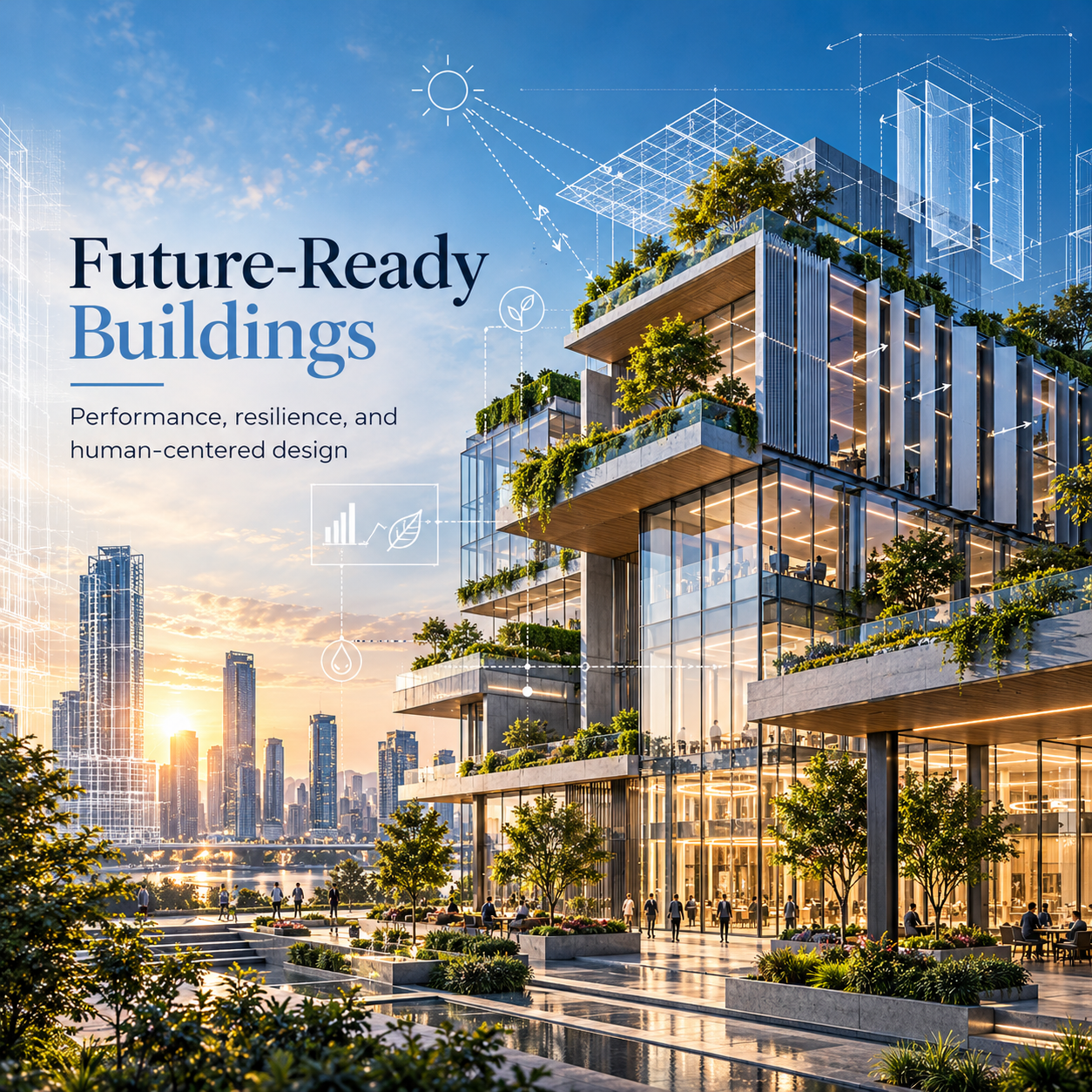
Smart Architecture Is Moving From Gadgets to Infrastructure
Technology becomes architecturally important when it changes how a building operates, how occupants interact with it or how maintenance teams manage it.
Sensors and automated controls now regulate HVAC, lighting, access, plumbing fixtures, water delivery and facility monitoring. That makes power, commissioning and serviceability part of architectural coordination.
The useful question is no longer simply whether a device is “smart.” AEC teams need to understand what it senses, what it controls, how it responds to failure and what infrastructure supports its lifecycle.
Sensors and Controls Become Part of Building Operations
Smart-building systems can improve energy management, water control and operational visibility, but automatic devices introduce new technical dependencies.
Commercial Restrooms Combine Water, Sensors and Facility Operations
Public and commercial restrooms bring several architecture trends 2026 together in one compact environment: water efficiency, accessibility, automatic sensing, power, hygiene, material durability and maintainability.
A touchless faucet is therefore more than decorative plumbing trim. It is a sensor-controlled water-delivery assembly involving a spout, sensor, valve, solenoid, power source, flow device and often a mixing component.
For architects and engineers, the complete assembly needs to be coordinated with basin geometry, countertop design, plumbing pressure, electrical requirements and maintenance access.
Touchless Faucets Should Be Specified as Complete Systems
A high-quality commercial sensor faucet cannot be evaluated by appearance alone. The sensing system, hydraulic controls, power source and basin geometry determine real installed performance.
Sensor Detection
The activation zone should correspond with the actual user hand position.
- Detection range
- Activation latency
- Shutoff response
- False-trigger resistance
- Adjustment method
Hydraulic Performance
Flow must be coordinated with the selected lavatory and expected user activity.
- Rated flow
- Operating pressure
- Spray pattern
- Splash containment
- Mixing strategy
Power Architecture
Power selection affects rough-in requirements and future maintenance.
- Battery
- AC
- Hybrid
- Hydropower / turbine
- Failure behavior
Service Access
Service components should remain accessible below or above the counter.
- Solenoid
- Filter
- Battery
- Mixer
- Isolation valve
Touchless Faucets From Leading Commercial Brands
The products below illustrate different approaches to commercial sensor faucets. Each faucet is displayed inside a square image container using object-fit: contain so the complete fixture remains visible. The manufacturer name is shown directly beneath each image.

Architectural Commercial Sensor Faucets
FontanaShowers offers commercial touchless faucets across deck-mount, wall-mount and multiple architectural form factors. Depending on the exact model, commercial collections may include different sensing technologies, finishes, AC/DC power configurations and flow options.

Commercial Infrared Sensor Faucet
BathSelect commercial sensor faucet platforms include infrared activation with project-specific power and mixing arrangements. Under-counter components should be coordinated early so batteries, solenoids, filters and mixers remain accessible.

Bau Cosmopolitan E
GROHE electronic faucet platforms use infrared activation with automatic water control. Selected models include battery or AC power options and programmable operating or hygiene functions.

GM ECOPOWER
TOTO ECOPOWER faucets use water-driven self-generation on applicable models, reducing dependence on routine battery replacement. The sensor is positioned close to the spout outlet to support on-demand handwashing operation.

BASYS Sensor Faucet
Sloan BASYS is designed specifically for commercial washrooms and emphasizes service access, sensor control and multiple power configurations. Selected versions provide above-deck access to key components for maintenance.

Kinesis Touchless Faucet
KOHLER’s commercial Kinesis platform integrates touchless sensing into several architectural spout profiles. Current ranges include different power, mounting and valving configurations depending on model.
Commercial Touchless Faucet Platforms Compared
Brand comparison is useful only as an initial shortlist. Final approval should always be based on the exact submitted model and configuration.
| Brand | Example Platform | Sensor Approach | Power Strategy | AEC Review Focus |
|---|---|---|---|---|
| FontanaShowers | Commercial sensor collections | Model-specific sensing | AC/DC depending on product | Detection zone, basin geometry, flow, finish and service access |
| BathSelect | Commercial automatic sensor faucets | Infrared | AC/DC on selected models | Pressure, timeout, mixer and under-counter maintenance |
| GROHE | Bau Cosmopolitan E | Infrared | Battery / AC depending on configuration | Temperature, programming, power and regional configuration |
| TOTO | GM ECOPOWER | Micro-sensor | ECOPOWER / AC depending on model | Flow, self-generation, mixing and controller location |
| Sloan | BASYS | Active infrared; selected alternate sensor platforms | Multiple commercial power strategies | Above-deck service, diagnostics, power and spray configuration |
| KOHLER | Kinesis | Concealed touchless sensing | AC / DC depending on model | Sensor behavior, mixer, valving and below-counter service |
Touchless Faucets Must Be Specified With the Lavatory
Sensor reliability and splash performance depend on the complete faucet-and-basin assembly rather than the faucet alone.
Low Flow Should Be Evaluated With Handwashing Performance
A lower GPM value can reduce water use, but effective specification also requires appropriate coverage, user comfort and basin compatibility.
Commercial touchless faucets may be available in very low-flow configurations, but the lowest number is not automatically the best choice for every restroom. The intended application and wash station geometry should guide the selection.
Flow Rate
Record the exact outlet and rated flow used for the project.
- 0.35 GPM commercial low-flow options
- 0.5 GPM common sensor-faucet options
- Other model-specific flow configurations
Run Time
Automatic faucets control consumption through both flow and activation duration.
- On-demand activation
- Automatic shutoff
- Maximum continuous run protection
- Model-specific metered functions
Power and Temperature Control Should Be Resolved Before Rough-In
| Design Item | Typical Options | AEC Coordination |
|---|---|---|
| Power | Battery, AC, hybrid, hydropower or turbine | Electrical rough-in, access and power-failure behavior |
| Mixing | Cold only, manual below-deck mixer, thermostatic mixer | Temperature strategy and adjustment access |
| Solenoid | Integrated or remote | Isolation and replacement clearance |
| Sensor Setup | Factory-set, self-adjusting or adjustable | Basin reflection and user position |
| Auto Flush | Available on selected platforms | Programming and facility water-management strategy |
| Monitoring | Standalone or connected depending on platform | Network, software, data and cybersecurity requirements |
Commercial Touchless Faucet Technical Specification
The final schedule or submittal should clearly identify the following information so that the faucet is evaluated as a complete operational assembly.
Test Touchless Faucets Under Final Installed Conditions
Sensor faucets should be tested after the basin, counter, lighting and surrounding finishes are installed because those conditions can influence sensing and splash behavior.

Brand Information Should Lead to Exact-Model Evidence
Manufacturer collection pages are useful for discovering fixture types and system options, but they should not replace the exact product submittal.
Flow, sensor behavior, power, dimensions and temperature-control arrangements can differ significantly between products within the same manufacturer.
Technical claims should therefore be traced from the brand overview to the exact model, specification sheet, installation document and maintenance instructions used for the project.
Technical Sources for Architecture & Touchless Faucet Specification
Architecture Trends 2026 Reach All the Way to the Faucet
The most important architecture trends 2026 are systems-level changes. Buildings are expected to consume fewer resources, adapt more easily, operate more intelligently and remain maintainable throughout their service life.
Commercial touchless faucets demonstrate this shift at a practical scale. A seemingly simple plumbing fixture can now integrate sensing, hydraulics, electronics, temperature control, accessibility, service access and—in selected platforms—digital monitoring.
Whether a project evaluates FontanaShowers, BathSelect, GROHE, TOTO, Sloan, KOHLER or another manufacturer, the strongest specification moves beyond brand recognition and documents exact-model performance, installation geometry, commissioning criteria and lifecycle service requirements.
That is ultimately the direction of high-performance architecture in 2026: the building is only as intelligent as the technical coordination behind every system that occupants and facility teams depend on.