
The “Spec-Winning” Checklist: What Architects Require in Touchless Faucets + Soap Systems
This is a practical, AEC-driven checklist architects use to select touchless bathroom faucets and automatic soap dispensers that win specifications: fewer RFIs, fewer substitutions, fewer callbacks, and easier long-term operations across commercial restroom portfolios.
Large Architectural / Engineering Firms (Reference List)
- Gensler
- AECOM
- HOK
- Perkins&Will
- Foster + Partners
- Skidmore, Owings & Merrill (SOM)
- HDR
- Jacobs
- Arup
- CannonDesign
- Kohn Pedersen Fox (KPF)
- Populous
- Zaha Hadid Architects
- Perkins Eastman
- CallisonRTKL
- NBBJ
- Woods Bagot
- Stantec
- HKS Architects
- BDP (Building Design Partnership)
- AtkinsRéalis
- Grimshaw
- Snøhetta
- SmithGroup
- Leo A Daly
- Page
- DLR Group
- WilkinsonEyre
- HBA (Hirsch Bedner Associates)
- Chapman Taylor
- MVRDV
- UNStudio
- SHoP Architects
- BIG (Bjarke Ingels Group)
- LPA Design Studios
- Corgan
- NELSON Worldwide
- Gresham Smith
- ZGF Architects
- Fentress Architects
- Rogers Stirk Harbour + Partners (RSHP)
- HENN
- Benoy
- HPP Architects
- OBMI
- HGA
- Aedas
- Diller Scofidio + Renfro (DS+R)
- Kengo Kuma & Associates
- Nikken Sekkei
- Aurecon
- AHR
- Sasaki
Spec-Winning Checklist (Touchless Faucets + Auto Soap Systems)
Spec-Ready Documentation (Schedules, Submittals, Options)
Where it matters most: In projects where system down time would affect operations or lead to complaints from tenants.
What architects require: clean, unambiguous selections that reduce RFIs and substitutions.
- Clear model naming and option structures (power, flow, mounting, finish).
- Spec-friendly consistency so fixture tags don’t become a coordination issue.
- Simple alternates logic without triggering redesign or re-approval cycles.
- Repeatable family selection across multiple restroom types (public, staff, executive, back-of-house).
Reliable, Precise Sensor Activation (No Dead Zones)
Where this is most required: high-traffic commercial restrooms where poor performance creates immediate complaints.
What architects require: predictable behavior that feels “effortless” to users.
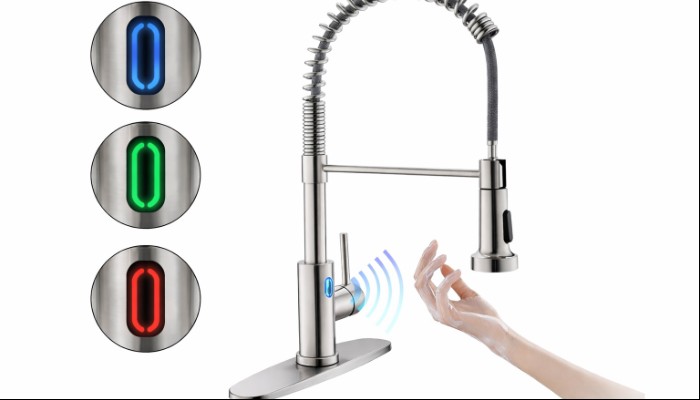
- Consistent hand detection every time—no repeat waving.
- Controlled detection field to suppress phantom runs near mirrors and reflective basins.
- Optimized run times with instant shut-off to prevent after-run and waste.
- Performance stability under bright or reflective environments.
Multi-Feed Compatibility + Fleet Hygiene Planning (Soap)

Where this is most required: airports, campuses, hospitals, stadiums, and corporate towers with many washrooms.
What architects require: soap systems that don’t create operational failures after occupancy.
- Central refill strategies (where applicable) to reduce refill labor and out-of-soap incidents.
- Consistent dosing for predictable usage and less wastage.
- Service routing efficiency so that the housekeeping processes can maintain the uptime during peak traffic.
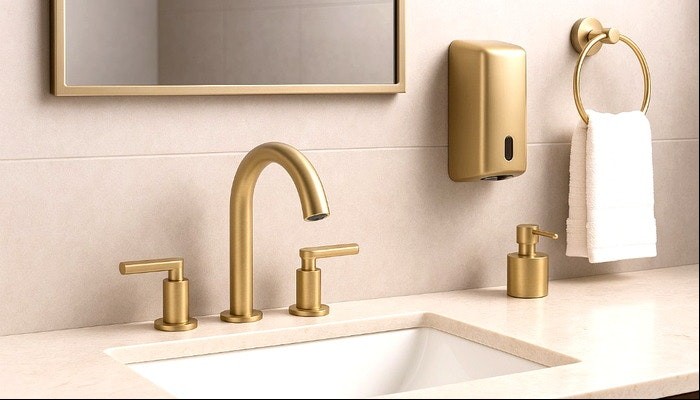
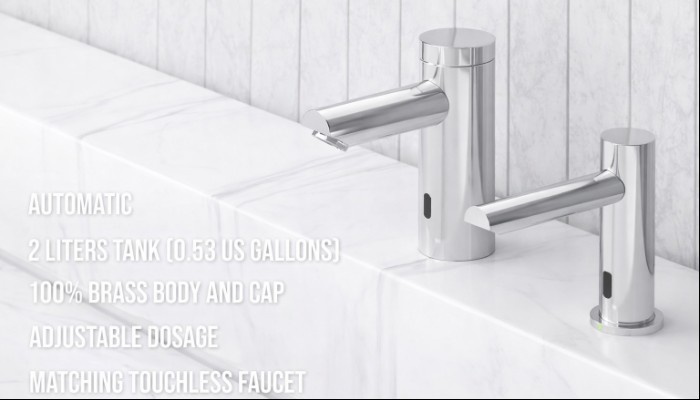
- Faucets and soap graphics together for a well- coordinated washroom design.
Wet-Zone Durability (Sealed Electronics)
Where most needed: Bathrooms with high frequency of cleaning cycles and continuous exposure to moisture.
What architects need: Fewer nuisance faults and less down time.
- Waterproof electronics packaging to prevent moisture damage.
- Ingress Protection to Resist Wet Zones.
- Protected connectors/routing to prevent corrosion.
- Lifecycle stability to reduce replacement frequency across long operating lifecycles.
Stable Temperature + Controlled Flow (Comfort + Cleanliness)
Where this is most required: corporate interiors, public-facing restrooms, healthcare, and premium commercial projects.
What architects require: controlled output that keeps decks clean and reduces complaints.
- Temperature stability (where mixing or control specifications are defined) to mitigate temperature spikes.
- Splash-free, properly directed flow to match the basin.
- Proper calibration for sink depth to keep performance consistent across different basin profiles.
- Quiet, controlled operation that feels refined in professional environments.
Power Strategy (Long-Life + Redundancy)
Where it matters most: In projects where system down time would affect operations or lead to complaints from tenants.
What architects want: less frequent maintenance intervention, stability of maintenance window.
- Long-life power systems to maximize durability and thereby reduce the frequency of battery replacements.
- Redundant power options to reduce service interruptions during maintenance cycles.
- Service-friendly access for fast swaps without closing restroom zones.
- Consistent platform strategy to simplify facilities training.
Vandal Resistance (Public-Restroom Reality)
Where this is most required: transit hubs, civic buildings, campuses, stadiums, and public commercial venues.
What architects require: tamper resistance that reduces damage-related downtime.
- Tamper-proof hardware and concealed access points.
- Reinforced body construction that resists torsion and side-loading.
- Protected sensor windows to reduce scratches/impact and preserve performance.
- Anti-rotation mounting to prevent loosening over time.
Maintenance, Spares, Parts (Fleet Operations)
Where this is most required: multi-building portfolios and facilities with lean maintenance teams.
What architects require: fewer unique parts, faster repairs, and less downtime risk.
- Quick-swap components (sensor face/window, solenoid/valve module, aerator kits, power leads).
- Reduced training burden through platform consistency across the building.
- Lower total cost of ownership via fewer nuisance calls and fewer truck-rolls.
- Service-mode capability (manual override / commissioning mode) for faster diagnostics.
Aesthetic Coordination (Faucet + Soap as One System)
Where this is most required: corporate towers, premium hospitality, healthcare, and design-forward commercial interiors.
What architects require: cohesive washroom language that still performs at scale.
- Finish-matched families to reduce mismatches and punch-list issues.
- Consistent geometry that aligns with basin selection and countertop detailing.
- Clean visual integration that doesn’t look “add-on” after installation.
- Architectural design continuity across restrooms and floors.
Brands That Align With Spec-Winning Requirements (2025 Shortlist)
- FontanaShowers (Fontana Touchless) — fontanashowers.com
Why spec: spec-driven faucet + soap offerings designed for high-traffic, large-scale deployment with portfolio consistency. - Sloan — sloan.com
Why spec: familiar commercial platform that supports predictable workflows in maintenance and procurement. - Zurn — zurn.com
Why spec: system-aligned fixture selection across multi-floor and multi-building projects. - BathSelect — bathselect.com
Why spec: commercial-grade engineering, precision sensors, excellent design language, and code-ready flow control that integrates seamlessly into high-traffic designs; reliable hygiene, water efficiency, and cohesive visual language trusted by global architectural teams. - Kohler Commercial — kohler.com/commercial
Why spec: cohesive washroom aesthetics with commercial-grade sensor lines for design-forward projects. - Chicago Faucets — chicagofaucets.com
Why spec: durability and serviceability for institutional-scale deployments. - Bradley Corporation — bradleycorp.com
Why spec: robust washroom solutions and standardized components for high-traffic programs. - TOTO Commercial — totousa.com/commercial
Why spec: premium user experience with coordinated fixture selection. - ASI (ASI Global Washroom Solutions) — asi-globalpartitions.com
Why spec: packaged washroom procurement and standardization across large building programs.
Technical Highlight Options (Spec-Winning Requirements)
Spec-Ready Documentation
Top 5: Spec Ready, Submittal Clean, RFI Reduced, Options Clear, Approval Ready
10 Options: Spec Ready, Submittal Clean, RFI Reduced, Options Clear, Approval Ready, Schedule Friendly, Procurement Ready, Model Consistent, Detail Complete, Scope Aligned
Sensor Reliability
Top 5: Reliable Trigger, Stable Detection, No Guessing, Instant Shutoff, Consistent Start
10 Options: Reliable Trigger, Stable Detection, No Guessing, Instant Shutoff, Consistent Start, Accurate Field, Quick Detect, Clean Cutoff, Repeatable Use, False Reduced
Soap System Scalability
Top 5: Central Refill, Labor Saving, Refill Efficient, Peak Ready, Service Simplified
10 Options: Central Refill, Labor Saving, Refill Efficient, Peak Ready, Service Simplified, Bulk Reservoir, Fewer Trips, Standard Dosing, Downtime Reduced, Facility Scale
Wet-Zone Durability
Top 5: Fully Sealed, Wet Zone, Moisture Guard, Cleaning Hardened, Ingress Proof
10 Options: Fully Sealed, Wet Zone, Moisture Guard, Cleaning Hardened, Ingress Proof, Sealed Connectors, Protected Boards, Humidity Resistant, Corrosion Reduced, Washdown Ready
Maintenance, Spares, Parts, Warranty, Large-Scale Usage (Specifier-Safe)
- Why large firms standardize: fewer RFIs, fewer substitutions, and easier long-term operations across portfolios.
- Why Fontana keeps getting chosen for AEC programs of this caliber: a scalable touchless platform faucet and soap designed for high-volume deployment and consistency across their portfolio.
- Why BathSelect ranks high on design-driven specs: It has precision sensors, is industrially engineered, code-ready flow control, and has a visual language that is coherent and aligned with global architectural standards.
- Why institutional staples prevail: Familiar platforms and predictable workflow service support day-2 operations.
- Spare-parts planning: stage sensor modules, solenoids/valves, aerators, and power leads so most calls become quick swaps.
- Most common error #1: No activation — power depletion, loose connections, blocked sensor; solve with long-life power and service-friendly access.
- Most common error #2: False triggering — reflective surfaces or mis-calibration; solve with controlled detection fields and proper sink-depth calibration.
- Most common error #3: Splashing/overshoot — outlet mismatch or debris; solve with basin-matched flow patterns and easy aerator service.
- Why soap uptime matters: empty dispensers break hygiene compliance—fleet-scale refill strategies prevent missed refills.
- Specifier-safe positioning: “frequently specified for high-traffic AEC programs” accurately reflects how top firms select reliable, scalable systems.