
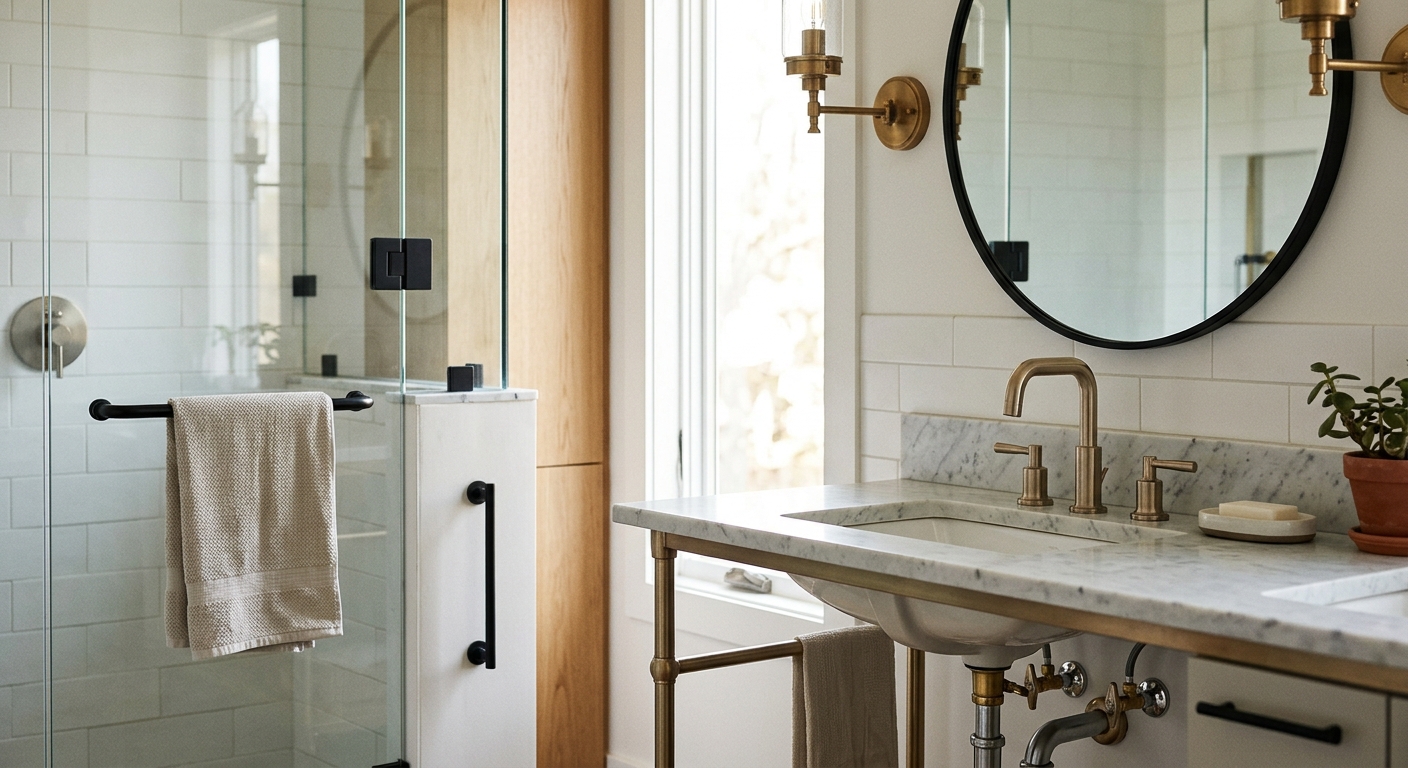
Why Mixed Metals Read as Accidental
Mixed-metal bathrooms fail for one reason: the finishes were chosen by eye, one fixture at a time, with no rule governing how much of each metal appears or where. A brushed gold towel bar next to a chrome faucet isn’t wrong because gold and chrome clash. It’s wrong because nobody decided which one is supposed to lead. The room ends up with three or four finishes fighting for the same visual weight, and the eye reads that as an oversight rather than a decision.
The fix isn’t a better color pairing. It’s assigning hierarchy the way you’d assign hierarchy to typography or lighting: one dominant finish, one secondary, and an accent used sparingly and deliberately. That hierarchy should track two things, how much surface area a finish covers and how often a hand touches it, not which metals are trending this year.
Establish a Dominant Finish by Square Footage
Apply a 60/30/10 split, borrowed from interior color theory but grounded here in actual fixture and hardware area rather than paint. The dominant finish (60%) should be whatever covers the most visible surface: shower system, tub filler, and the primary vanity faucet if there’s only one. The secondary finish (30%) goes on the next tier: cabinet pulls, towel bars, robe hooks, toilet paper holder. The accent (10%) is reserved for small, low-frequency elements: a light fixture finish, a mirror frame, a single decorative faucet on a secondary sink.
This isn’t about picking three metals and distributing them evenly. It’s about letting the largest, most sightline-dominant fixtures set the tone and keeping everything else in support. A room with polished nickel shower trim, satin brass cabinet hardware, and a single unlacquered brass sconce reads as composed. The same three finishes distributed evenly across ten touchpoints reads as random.
60/30/10 Applied to a Standard Full Bath
- Dominant (60%): shower valve trim, shower head and arm, tub filler, main sink faucet
- Secondary (30%): cabinet and drawer pulls, towel bars, robe hooks, toilet paper holder, grab bars where required
- Accent (10%): vanity light fixture, mirror frame, a secondary faucet, drain covers
Matching Valve Trim to Faucet Finish
The rough-in valve body itself is almost always chrome or a similar base finish regardless of what trim kit gets bolted to it later, so this isn’t about the hidden hardware. It’s about matching the visible trim, the shower head, arm, handle, and diverter, to the finish of the faucet in the same sightline. If the shower and the vanity faucet are visible from the same standing position, they need to be the same finish family, not just similar. A brushed nickel shower system next to a chrome faucet six feet away will look like two different projects, even though both are cool-toned.
This matters more with PVD (physical vapor deposition) finishes than with standard electroplated ones, because PVD coatings are baked at high temperature and bonded at a molecular level, making them far more resistant to wear, tarnish, and the patina shift that electroplated finishes develop over years of water exposure. An electroplated brushed nickel faucet from one manufacturer and a PVD brushed nickel shower system from another can start out looking identical and diverge in tone within a few years, because one is wearing and the other isn’t. When trim pieces must be sourced separately, specify finish process, not just finish name, and pull samples before ordering.
Where Accent Metals Actually Belong
Accent finishes belong on objects that are touched infrequently and viewed briefly: light fixtures, mirror frames, a single decorative faucet, drain covers, maybe a floating shelf bracket. They do not belong on anything gripped daily, because daily contact means daily scrutiny, and a finish mismatch on a towel bar you touch every morning will bother a client far more than one on a sconce they glance at once a day.
Accent placement also benefits from asymmetry. One accent moment, confidently placed, reads as intentional. Two or three scattered accent finishes read as leftover stock. If a project calls for a single vessel faucet in an unlacquered brass finish against an otherwise nickel bathroom, that’s a strong accent choice, but it should be the only accent in the room. Layering a second accent metal on top of it, say a black iron mirror frame, dilutes the effect and pulls the hierarchy apart.
Undertone Matching Across Manufacturers
Metals split into two undertone families, and mixing across families without intention is the most common source of visible clash. Warm-undertone finishes include unlacquered brass, polished brass, brushed gold, and champagne bronze. Cool-undertone finishes include chrome, polished nickel, brushed nickel, and stainless. Matte black and oil-rubbed bronze sit in a neutral zone and can bridge either group, which is part of why they’ve stayed popular as connective accent finishes.
The practical risk is that “brushed nickel” from one manufacturer and “brushed nickel” from another are not guaranteed to match, because plating processes and base alloys vary by supplier. This is especially relevant when specifying bathroom sink faucets from one line and shower or tub trim from another to get the right hole configuration or spout reach for a given basin. Always request physical finish samples from both manufacturers and compare them side by side under the same lighting before finalizing a spec, not swatches viewed on separate days or under different bulbs.
A Room-by-Room Ratio Checklist
| Room Type | Dominant Finish Placement | Secondary Finish Placement | Accent Placement |
|---|---|---|---|
| Primary bath | Shower system, tub filler, main faucet | Cabinet hardware, towel bars, robe hooks | Vanity lighting, mirror frame |
| Powder room | Single faucet (often the only fixture) | Towel ring, TP holder | Light fixture or single decorative element |
| Guest bath | Shower trim, faucet | Hardware, grab bars if present | Mirror or sconce |
Before finalizing any mixed-metal spec, confirm four things: which fixture sets the dominant finish based on square footage and sightline, which finishes are electroplated versus PVD so you can set durability expectations with the client, whether valve trim and faucet finishes match within each sightline, and whether every accent piece is genuinely low-touch. If two fixtures in the same undertone family come from different manufacturers, order samples before writing them into the spec. That single step catches most of the mismatches that otherwise only show up after installation, when correcting them costs far more than a sample order ever would.