
<!doctype html>
Civic & Transit Restroom Design 2026
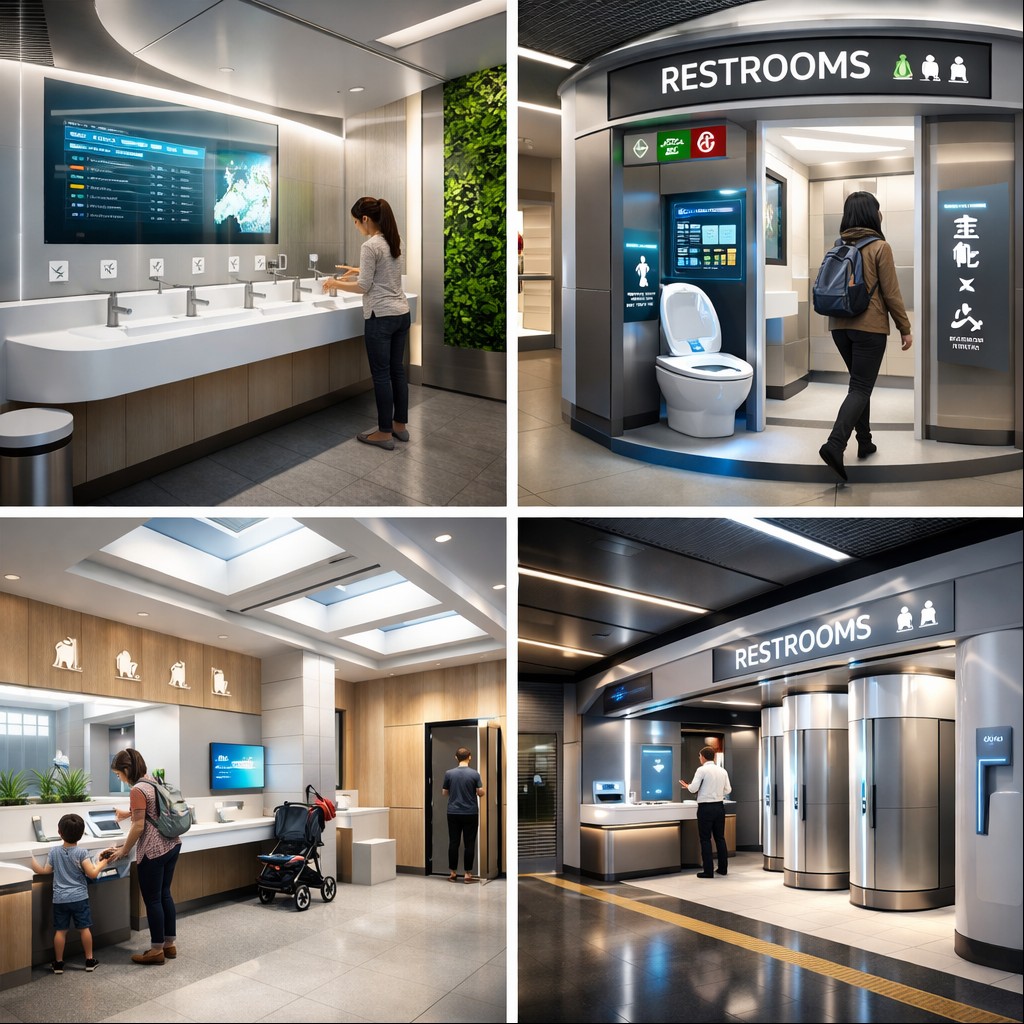
High-throughput, high-resilience restrooms for stations, airports, and civic venues — where safety and uptime are non-negotiable.
Why transit restrooms are different
Passenger spikes, luggage flow, and 18–24/7 operations stress layouts and fixtures beyond typical commercial use. Designs must withstand vandalism, enable rapid cleaning, and maintain safety and dignity in crowded conditions.
Safety & CPTED
Visibility & control
- Offset entries for privacy but maintain staff sightlines to wash zones.
- Lighting uniformity; eliminate shadow pockets.
- Cameras at approaches (per policy/law), not inside.
Hardware & behavior
- Anti-ligature fixtures where required; tamper-proof fasteners.
- Occupancy indicators; emergency release on full-height partitions.
- Clear signage, multilingual where relevant.
Codes & standards (verify local amendments)
| Topic | Target | Primary References |
|---|---|---|
| Accessibility | Lav rim ≤ 34″ AFF; operable parts without tight grasp | 2010 ADA Standards; ICC A117.1 |
| Plumbing | Fixture counts; lav ≤ 0.35 GPM; WCs ≤ 1.28 gpf; urinals ≤ 0.5 gpf | IPC / UPC; WaterSense |
| Ventilation | Exhaust & dilution; negative pressure to concourses | ASHRAE 62.1 |
| Slip resistance | Wet DCOF per product claim & test | ANSI A326.3 |
| Hygiene guidance | Handwashing & cleaning protocols | CDC; ISSA |
| Sustainability | Water/IAQ credits; product transparency | LEED v4.1; WELL v2 |
Throughput-first layouts
Dual-entry loop
Separate entry/exit doors reduce counter-flow; place vanities central to shorten dwell.
Island wash with queuing lanes
Island basins and clear lanes reduce luggage bottlenecks; integrate stroller/ADA widths.
All-gender suite
Private full-height stalls around shared wash increase flexibility; confirm approvals.
Pop-up pods
Temporary modular units for events or construction phases; connect to portable services.
Fixtures, touchless & water
Lavatories
- IR faucets with 0.35 GPM aerators; latency 150–300 ms; shut-off ≈ 0.3 s.
- Thermostatic mixing (ASSE 1070); anti-scald limits.
- Spout throw matched to basin; splash testing at commissioning.
Toilets & urinals
- WaterSense-listed flush valves; pressure-assist or high-rated bowls.
- Hands-free flush; isolation valves and access panels.
- Queue-aware stall indicators reduce door rattle and disruptions.
Metering & analytics
- Sub-meter handwash zones; log activations; anomaly alerts for leaks and runtimes.
- Use traffic counters to align housekeeping and staffing.
Materials & vandal resistance
Surfaces
- Stainless, solid surface, or porcelain; coved bases; epoxy grout.
- Anti-graffiti coatings on vulnerable panels.
Partitions & hardware
- Phenolic/compact laminate; anti-tamper fasteners; out-swing doors with indicators.
- Edge/impact guards in corridor pinch points.
Cleanability
- Minimize ledges; slope to drains; hose bibbs with backflow prevention.
- Chemistry compatibility matrix; color-coded tools.
Ventilation, odors & acoustics
Ventilation
- Design per ASHRAE 62.1; typical exhaust 10–12 ACH; maintain negative pressure.
- Service access for fans & filters; odor capture near urinals.
Acoustics
- Ceiling NRC ≥ 0.70; isolate loud dryers or select low-sone models.
- Door seals/sweeps; consider masking at entries if needed.
Lighting
- 50 fc at mirrors; CRI ≥ 90; IP-rated luminaires in wet zones.
- Occupancy sensing; avoid glare and shadowing at vanities.
Operations & maintenance
Serviceability
- Access panels to valves, controllers, traps.
- Standardize SKUs; stock critical spares; QR O&M sheets at chase.
Cleaning workflow
- One-way cleaning routes; touchless bins; scheduling via traffic counters.
- Sub-meter & log to tune delays/flows post-occupancy.
Commissioning & emergency modes
- Verify ADA/A117.1 heights, clearances, operability.
- Set lav flow to 0.35 GPM; sensor delay ≈ 0.3 s; splash test on representative users and luggage scenarios.
- Balance exhaust; confirm negative pressure and noise limits.
- Program alarms for leaks, abnormal runtimes; integrate with station ops.
- Define emergency cleaning and closure procedures (spill, outage, incident).
References
- 2010 ADA Standards for Accessible Design
- ICC A117.1 Accessible & Usable Buildings & Facilities
- International Plumbing Code (jurisdictional adoption) / Uniform Plumbing Code
- EPA WaterSense
- ASHRAE 62.1: Ventilation
- ANSI A326.3: Slip Resistance
- LEED v4.1: Water Efficiency
- WELL Building Standard v2
- CDC Handwashing & Hygiene Guidance
Transit owners should also align with agency design manuals (e.g., airport authorities, transit agencies) and security policies.
Have a transit or civic restroom project?
architecturaldaily.org publishes architect-ready guides and case studies. Share your work with our editors.