
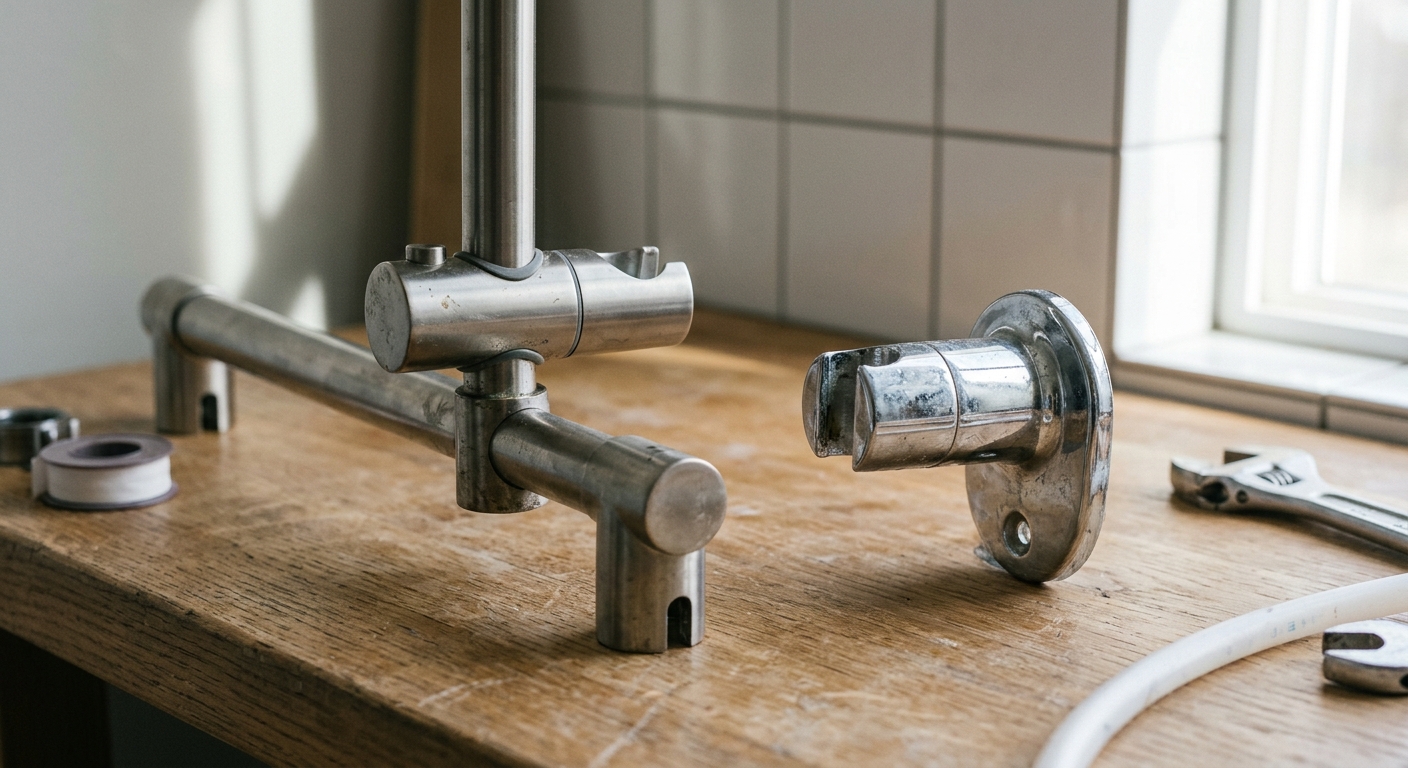
Spec a fixed bracket if you want the finish to age as one surface, and a slide bar if the household genuinely needs adjustable height. That used to be an ergonomics call. On a high-end job where you have put real money into unlacquered brass or a PVD matte black, it is now a finish-wear call first and a reach calculation second.
Why This Comparison Is a Finish Problem
A fixed bracket has one contact point: the wall rose and the handheld cradle. A slide bar has a carriage that travels the length of the bar, a release button or lever that gets thumbed daily, and a bar surface that takes the brunt of hard water, soap film, and the cradle’s own friction every time someone changes height. Multiply that by years of use and you are not comparing two mounting styles, you are comparing one static finish against one that gets mechanically polished in a stripe down its length whether you want that or not.
This matters more now because so many of the finishes architects are specifying, unlacquered brass, burnished bronze, matte black PVD, are chosen precisely because they are supposed to age visibly and evenly. A slide bar does not let a finish age evenly. It creates a bright track where the carriage rides and leaves the rest of the bar to patina or oxidize at its own rate. On a fixed bracket, the whole fixture weathers together.
Contact Points and Coating Wear Patterns
Walk through where metal touches metal on each setup:
- Slide bar: carriage-to-bar contact (continuous sliding friction), release mechanism (repeated thumb pressure, often brass-on-brass or brass-on-steel), end stops (impact wear), and the wall brackets at top and bottom (static, like a fixed bracket).
- Fixed bracket: wall rose (static), cradle socket (occasional insertion wear from the handheld), and the swivel joint if the bracket angles (low-frequency, low-friction).
The slide bar’s carriage path is the problem zone. Brushed nickel and brushed brass are especially vulnerable here because the brushed texture is a mechanical finish, fine parallel scoring, and repeated sliding contact burnishes that texture smooth in the travel zone while leaving the rest of the bar textured. You end up with a visible shiny stripe inside six months to two years depending on water hardness and household size. PVD finishes resist this far better because the coating is a vapor-deposited layer bonded at a near-molecular level rather than a mechanical surface texture, so it does not burnish the same way under sliding friction. It can still scratch under abrasive grit in hard water, but it holds its sheen and color more uniformly than brushed nickel at the same contact points.
Slide Bar Mechanics and Sizing Standards
If the project calls for a slide bar regardless of the wear tradeoff, because the client wants adjustable height for kids, for seated bathing, for a multi-generational household, size it correctly. Standard slide bar lengths run 450mm to 900mm per common EN 1111 ranges, with 600mm being the most typical residential length for a single adjustable user and 900mm bars specified where the household spans a wide height range or where a bench seat needs the lower end of the travel. Shorter 450mm bars show up in secondary or guest baths where adjustability is a convenience feature, not a daily necessity.
Check the carriage material before you spec. Some manufacturers use a different alloy or a different finish process for the carriage than for the bar itself, which means the two components can age at different rates even before friction wear comes into play. Ask for the carriage finish spec separately from the bar finish spec on any high-end order.
Fixed Bracket Height and Rough-In Rules
Fixed wall brackets typically set at 1,800 to 2,000mm per code ergonomic guidance, with the exact height driven by user height, ceiling height, and whether the bracket is angled or fixed-straight. This is a rough-in decision made early, usually locked in with the valve rough-in and tile layout, so there is no adjusting after the fact the way there is with a slide bar. That is the tradeoff: less flexibility, but a cleaner installation with fewer moving parts to maintain and a finish that will not develop a wear track.
On both bracket and slide bar hardware, the supply and mounting connections are standardized. G1/2 (1/2 in BSP) thread remains standard across both bracket and slide bar fittings, which means swapping between a fixed bracket and a slide bar kit on an existing rough-in is usually a fitting-compatible swap, not a plumbing change. That is useful to know if a client wants to reconsider hardware style after tile is already set.
Which Trend Finishes Survive Which Hardware
| Finish | Fixed Bracket | Slide Bar |
|---|---|---|
| Unlacquered brass | Ages evenly, patina develops as intended | Carriage track burnishes bright, uneven patina |
| Matte black PVD | Holds uniform matte finish | Resists wear well, best PVD option for slide bars |
| Brushed nickel | Stable, minor wear at cradle socket only | Visible burnish stripe at carriage path, fastest to show wear |
| Polished chrome | Very stable, hard surface | Tolerates friction well, least visually sensitive to wear |
| Brushed brass / warm gold tones | Even aging, patina-friendly | Shows wear stripe similarly to brushed nickel |
The pattern is consistent: hard, uniform-coating finishes like polished chrome and matte black PVD tolerate slide bar friction reasonably well, while mechanically textured or intentionally patina-prone finishes like unlacquered brass and brushed nickel show wear fastest at the carriage path. If a client has already committed to a brushed gold or unlacquered brass palette elsewhere in the bathroom, maybe at the vanity, where brushed gold basin faucets are doing a lot of visual work, a fixed bracket in the shower keeps that material language consistent instead of introducing a wear pattern that reads as damage rather than patina.
Specifying for Longevity, Not Just Reach
Before locking the spec, run through this:
- Confirm whether the household genuinely needs adjustable height, or whether a single well-chosen fixed height (1,800 to 2,000mm, confirmed against the tallest and shortest regular users) covers it.
- If adjustability is non-negotiable, choose PVD or polished chrome over brushed nickel or unlacquered brass for the slide bar and carriage specifically, even if the rest of the bathroom runs warm metals.
- Verify G1/2 thread compatibility if there is any chance of switching bracket style later without re-piping.
- Ask the manufacturer for the carriage finish spec separately from the bar finish spec, since mismatched aging between the two is a common and avoidable complaint.
- For guest baths or secondary showers where wear patterns matter less to the client, the finish-durability argument carries less weight and a slide bar is simply the more practical choice.
Where the project budget and finish ambition are both high, bring in the installer or fixture rep before final selection. They will have seen how a given PVD line or brushed finish actually wears in the field, which is more reliable than a spec sheet when the whole point of the fixture is how it looks in five years, not just on delivery day.