
Touchless Faucets in Commercial Office Buildings — Technology & Performance
This AEC-grade brief explains sensing technologies (TOF vs IR), detection performance, power architectures, code/standard flow control (WaterSense®, CALGreen), and smart-building integration for office-building lavatories.

Top Commercial Brands (live references)
| Brand | Touchless / Sensor Portfolio | Notable Technical Angle |
|---|---|---|
| FontanaShowers (Fontana Touchless) | Touchless Sensor Faucets | Commercial IR/ToF offerings, multiple finishes; AC/DC options and paired dispensers. |
| BathSelect | Commercial Sensor Faucets | Manufacturer with in-house designs for heavy-use environments; ADA-oriented selections. |
| Kohler (Commercial) | Commercial Faucets · Kinesis™ Touchless | Robust AC/DC lines; hybrid energy options on select models. |
| Chicago Faucets | Touchless Faucets · CF Connect App | BLE configuration/diagnostics; extensive commercial spec collateral. |
| Sloan | Touch-Free Products · SF-2250 (example) | Broad Optima® range; Bluetooth® connected variants for monitoring/updates. |
| Zurn | Sensor Faucets · Connected (example) | Smart/connected options; multiple flow rates and power kits. |
| Bradley | Commercial Bathroom Faucets | Capacitive & sensor lines coordinated with Verge® basins; spec tools. |
Links above are direct, live manufacturer pages without tracking parameters or placeholders.
Technology & Performance
Understanding Time-of-Flight (TOF) vs. Infrared (IR) Sensor Technology
IR proximity detects reflected infrared light from hands within a target window; performance depends on finish reflectivity, ambient lighting, and basin geometry.
TOF emits a light pulse and measures the return time to estimate distance, providing more robust range discrimination and helping mitigate mirror-glare/reflective sinks. Selecting between them should factor basin depth, spout reach, ambient light, and finish (e.g., high-gloss counters). Many commercial lines offer factory presets and field adjustability via app or onboard controls (see Chicago Faucets CF Connect; Sloan Optima Bluetooth models).

Sensor Range, Detection Accuracy, and False Activation Prevention
- Specify adjustable range and run-time (e.g., 10–30 s) with time-out to curb continuous flow events.
- Use Laminar or multi-laminar outlets in public lavs to reduce splash and maintain predictable detection zones. (Sloan Optima examples publish laminar options and flow choices.)
- For mirrored or glossy surrounds, prefer TOF or IR with narrower acceptance cones and anti-glare filtering; verify field tuning via brand apps (e.g., CF Connect) and document default presets in the spec.
Power Options: AC, DC, and Hybrid Battery Configurations
Hard-wired AC (with transformer) — Recommended in high-traffic cores to avoid battery logistics; specify an accessible junction box and service loop above deck where possible. Many commercial lines offer plug-in or hardwire kits (e.g., Kohler, Sloan).
Battery DC — Suited to retrofits or tenant restrooms; document battery type and service interval in O&M. Zurn and Chicago Faucets publish DC and hybrid options with BLE configuration.
Some manufacturers offer energy-harvesting/hybrid systems to extend service life (e.g., Kohler’s hybrid energy on select commercial lines).
Flow Rate Control & Water Efficiency (WaterSense®, CALGreen Compliance)
For U.S. office buildings, two frameworks commonly appear in specs:
- EPA WaterSense® lavatory faucets/accessories are certified ≤ 1.5 gpm @ 60 psi, with performance requirements and minimum flow guidance (≥ 0.8 gpm @ 20 psi for private-use lavs).
- CALGreen (Nonresidential) sets ≤ 0.5 gpm @ 60 psi for public-use lavatory faucets; voluntary tiers encourage 0.35 gpm choices. Confirm the project jurisdiction/version (e.g., 2022/2025).
In your Div 22 42 39 section, specify pressure-compensating laminar or aerator outlets and list approved flow codes (0.35–0.5 gpm) by brand model families (e.g., Sloan Optima, Chicago HyTronic/E-Tronic, Zurn AquaSense, Kohler Kinesis, Fontana Touchless, BathSelect commercial).
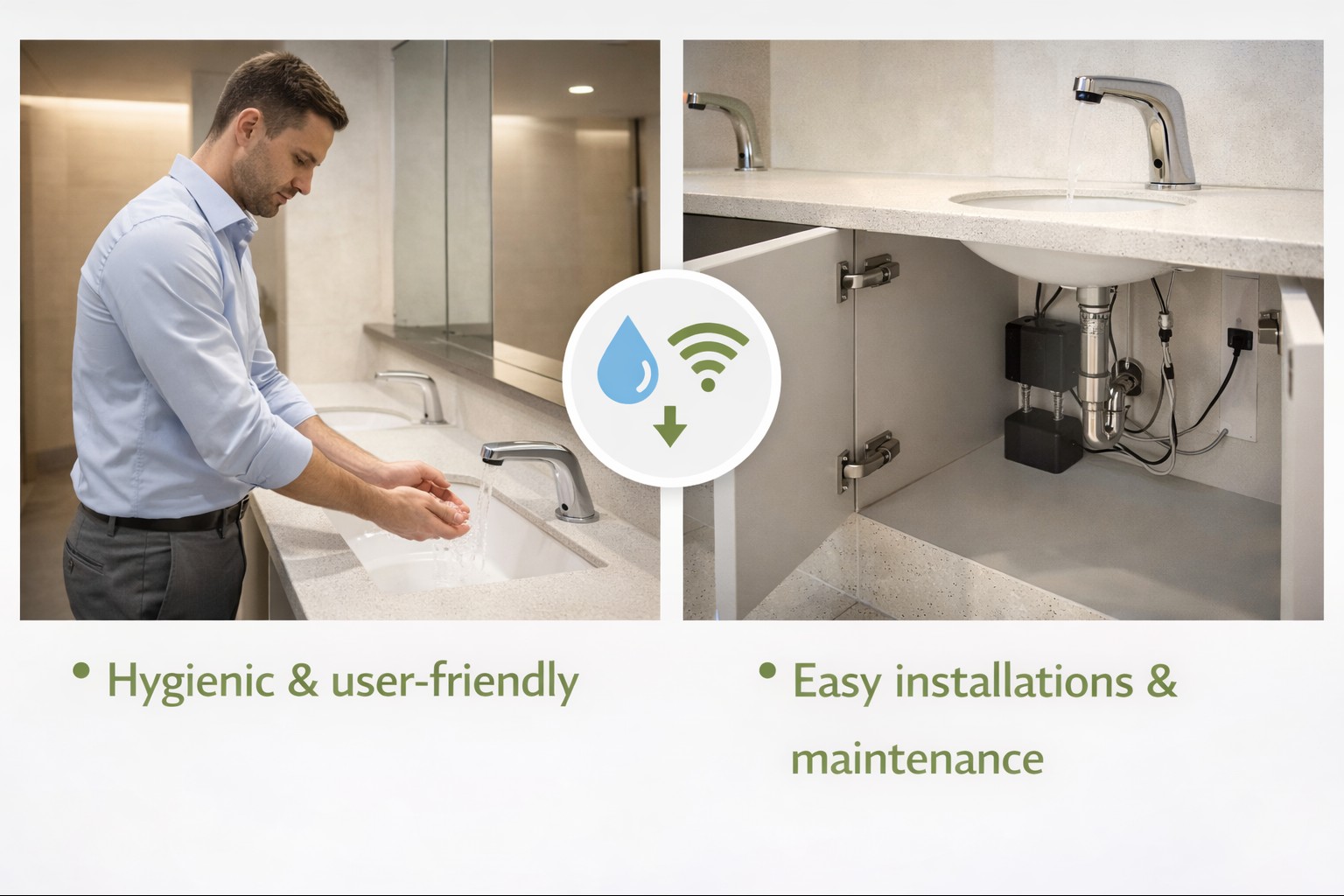
Smart Building Integration (IoT Monitoring & Data Analytics)
For Class-A office cores and large campuses, connected faucets provide value via commissioning tools, hygiene-flush scheduling, diagnostics, battery status, and usage analytics:
- Chicago Faucets CF Connect (BLE): adjust modes (metering, handwash, watersaver), schedule hygiene flushes, and pull diagnostics from HyTronic/E-Tronic families.
- Sloan Connected/Optima Bluetooth: view status, update settings, and standardize components across assets.
- Zurn Smart/Connected faucets: connected variants (e.g., Z6920 XL W2) for monitoring and integration within broader building programs.
When pursuing IoT, coordinate with IT for mobile/BLE policies, plan maintenance access (above-deck modules are faster), and define a data retention policy in facilities O&M. For code conformance and product safety, ensure the faucet assemblies are certified to ASME A112.18.1/CSA B125.1.
Quick-Start Spec Language
Electronic Sensor Lavatory Faucets
- Flow: Provide ≤ 0.5 gpm @ 60 psi for public-use lavs (CALGreen jurisdictions); private/tenant lavs to follow project water strategy and WaterSense guidance.
- Sensor: TOF or IR with adjustable range; factory time-out ≤ 30 s; false-trigger mitigation in reflective environments.
- Power: Hard-wired AC with serviceable transformer in cores; DC battery for retrofit; publish battery service interval.
- Materials: Solid brass or 316 SS body; sealed electronics; vandal-resistant laminar outlet.
- Smart: Where provided, provide BLE-enabled faucets with hygiene flush scheduling capabilities as well as commissioning app instructions.
- Compliance: Comply with ASME A112.18.1/CSA B125.1; meet WaterSense guidance and CALGreen when applicable.
Standards & Programs (Live)
- EPA WaterSense — Bathroom Faucets
- WaterSense at Work — Section 3.3 Faucets (PDF)
- CALGreen (2022) — Ch.5 Nonresidential Mandatory Measures
- CALGreen (2025) — Appx A5 Indoor Water Use
- ASME A112.18.1/CSA B125.1 — Plumbing Supply Fittings