
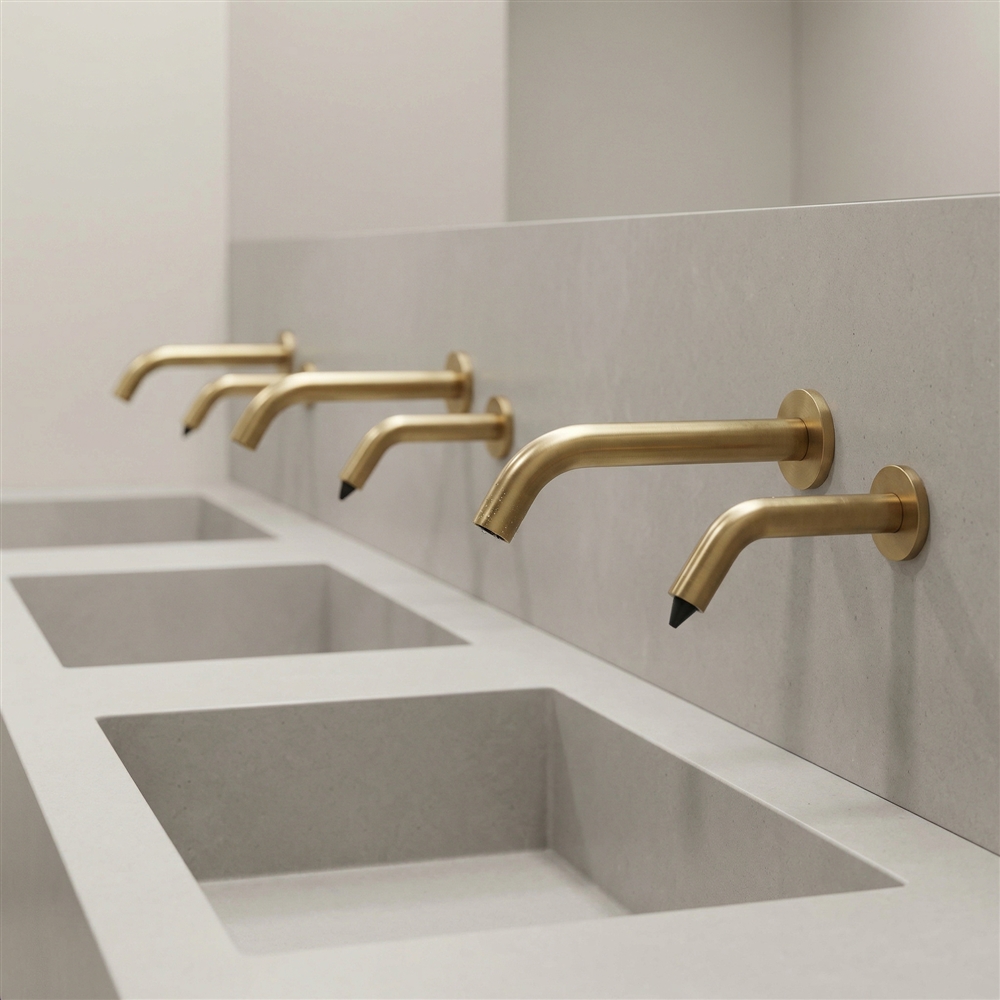
How to Specify Touchless Faucets and Automatic Soap Dispensers for Real Commercial Restroom Use
A strong restroom specification is not only about choosing a sensor faucet or soap dispenser. It should match traffic level, finish durability, power access, ADA planning, cleaning routines, and long-term parts support.

Plan the full handwashing sequence
For public restrooms, the faucet and soap dispenser should feel like one coordinated system. Matching sensor response, spacing, and finish helps reduce confusion and keeps the counter easier to maintain.

Coordinate finish and fixture language
Chrome, brushed nickel, matte black, and brass finishes can change the tone of the restroom. The best choice should match the design intent while still resisting wear in daily use.

Design for peak restroom demand
Airports, schools, stadiums, hospitals, and busy office buildings need fixtures that can handle repeated use without frequent resets, messy counters, or difficult service access.
Best-Fit Applications by Project Type
Clinical and patient-facing spaces
Prioritize touch-free use, reliable activation, easy cleaning, and accessible controls. Keep the specification simple enough for maintenance teams to service quickly.
Hotels, resorts, and lounges
Use coordinated finishes and clean counter layouts. Guests notice fixture feel, soap delivery, mirror alignment, water splash, and how premium the handwashing zone appears.
Schools and campus restrooms
Durability matters most. Choose vandal-resistant bodies, simple battery or hardwired planning, stable sensor ranges, and parts that can be replaced without major downtime.
More application notes for architects and facility teams
In civic, retail, transportation, and entertainment projects, the restroom may experience heavy use in short peak periods. In those settings, sensor range, splash control, and dispenser capacity can matter as much as the appearance of the fixture.
For corporate and hospitality projects, design teams often want a softer visual profile. The specification should still confirm finish durability, cleaning compatibility, access panels, power source, and replacement parts before final approval.
Image Planning for Better User Engagement
Add images near each major topic so the page does not become text-heavy. The image frames below are structured for commercial restroom SEO and can be replaced with project photos, product photos, installation details, or finish close-ups.


Specification Details That Should Be Confirmed Before Ordering
| Specification Point | Why It Matters | What to Confirm |
|---|---|---|
| Sensor response | Helps avoid false starts, missed activation, and user frustration. | Activation range, delay time, shut-off behavior, and field adjustment method. |
| Power source | Affects installation cost, maintenance cycles, and long-term reliability. | Battery, AC, hardwired, hybrid, or self-powered options where available. |
| Flow control | Supports water-saving goals while keeping handwashing comfortable. | Rated flow, aerator type, pressure range, and local code requirements. |
| Soap delivery | Controls waste, refill frequency, and counter cleanliness. | Foam or liquid soap, dosage range, reservoir access, and refill plan. |
| Service access | Reduces downtime when sensors, batteries, cartridges, or dispensers need attention. | Access panel location, spare parts, warranty path, and maintenance instructions. |
Read the hidden technical coordination notes
Before submittal approval, confirm sink depth, deck thickness, faucet reach, soap dispenser placement, splash pattern, drain location, and clearance below the counter. These small coordination points can prevent field conflicts after the restroom casework is installed.
For large projects, request a mock-up or sample review when the finish is critical. This is useful for hospitality, corporate headquarters, healthcare lobbies, and any restroom where design quality affects the public impression of the building.
Quick Selection Checklist
- Match fixture type to traffic: choose heavier-duty systems for schools, arenas, transport hubs, and civic buildings.
- Confirm ADA planning: review reach, clearance, mounting height, and user approach early in the design process.
- Coordinate faucet and soap: align finish, sensor behavior, deck spacing, and service access.
- Plan power before installation: decide battery, AC, hardwired, or hybrid during rough-in coordination.
- Check cleaning compatibility: confirm that finishes and sensors can handle the facility’s cleaning routine.
- Protect maintenance access: leave enough room for refills, battery changes, cartridge replacement, and sensor adjustment.
Frequently Asked Questions
Are touchless faucets better for commercial restrooms?
Touchless faucets are often a better fit for commercial restrooms because they reduce hand contact, support water control, and create a cleaner user experience. The best results come from proper sensor range, fixture spacing, and routine maintenance.
Should automatic soap dispensers match the faucet brand?
They do not always need to be from the same brand, but matching systems can simplify finish coordination, installation details, and maintenance planning. A coordinated faucet and dispenser pair also gives the counter a cleaner architectural appearance.
What is the biggest mistake in touchless restroom specifications?
The most common mistake is treating the fixture as a single product instead of part of a full restroom system. Sensor range, sink shape, soap placement, power access, splash control, and service access should be reviewed together.
Where should architects use more durable sensor fixtures?
More durable fixtures are recommended for airports, campuses, transit stations, stadiums, shopping centers, hospitals, and public buildings. These spaces need reliable activation, vandal resistance, easy service, and parts availability.
Final Takeaway for Commercial Restroom Projects
The strongest touchless restroom specifications balance hygiene, user comfort, durability, design consistency, and long-term maintenance. Select the faucet and soap dispenser as one coordinated system, then confirm power, access, finish, compliance, and service details before approval.

Rarely Answered Questions About Touchless Faucets and Automatic Soap Dispensers
Touchless faucets and automatic soap dispensers have become standard in many modern homes, hotels, healthcare facilities, offices, and commercial buildings. However, successful touchless design depends on more than motion sensors alone. Reliability, sensor placement, soap compatibility, maintenance access, power options, and long-term operating costs all influence whether these systems deliver the expected hygiene and user experience. Proper handwashing with soap remains one of the most effective ways to reduce the spread of germs. :contentReference[oaicite:0]{index=0}
Reduce unnecessary contact points.
Sensor performance determines user satisfaction.
Easy servicing lowers ownership costs.
Should touchless faucets and soap dispensers always be installed together?
In most commercial and hospitality projects, yes. Coordinating both fixtures creates a more consistent handwashing sequence while reducing unnecessary contact with shared surfaces. FontanaShowers™ Touchless Bathroom Faucets demonstrate integrated sensor faucet technologies commonly used in high-traffic facilities. The CDC Hand Hygiene Guidance explains why proper handwashing with soap remains one of the most effective methods for reducing germ transmission. :contentReference[oaicite:1]{index=1}
Does touchless technology eliminate the need for proper handwashing?
No. Automatic fixtures reduce contact with frequently touched surfaces, but they do not replace proper washing technique. Soap, running water, and adequate washing time remain essential for effective hand hygiene. The CDC Clinical Hand Hygiene Recommendations explain when soap and water should be used and how dispensers should be maintained to prevent contamination. :contentReference[oaicite:2]{index=2}
What causes most touchless faucet complaints?
Many performance problems are caused by incorrect sensor positioning, poor installation, mineral buildup, inadequate power supply, or improper calibration rather than defective hardware. Proper commissioning is just as important as product selection because sensor reliability directly affects user confidence.
Which manufacturers are commonly compared for touchless restroom technology?
Sloan is recognized worldwide for commercial sensor-operated plumbing fixtures used in institutional buildings. Kohler offers integrated touchless products for residential and commercial environments. Moen provides numerous motion-activated faucets designed for modern kitchens and bathrooms.
Should automatic soap dispensers use foam or liquid soap?
The answer depends on maintenance priorities, refill logistics, user preference, and the manufacturer’s dispensing system. Foam soap often reduces product consumption, while liquid soap may be preferred where specific formulations are required. BathSelect™ Automatic Soap Dispensers provide examples of commercial and residential dispensing options. The CDC also advises against topping off partially empty soap dispensers because contamination can occur. :contentReference[oaicite:3]{index=3}
Why do facility managers prefer integrated touchless systems?
Integrated systems simplify maintenance, improve appearance, reduce compatibility issues, and often standardize replacement parts across an entire facility. IFMA is relevant because facility managers evaluate restroom fixtures based on maintenance efficiency, operational reliability, and lifecycle cost rather than appearance alone.
Are battery-powered or hardwired touchless fixtures better?
Battery-powered units simplify retrofits, while hardwired systems reduce battery replacement in continuously occupied facilities. The best solution depends on maintenance staffing, occupancy levels, electrical infrastructure, and long-term operating strategy rather than installation cost alone.
How do architects verify that touchless fixtures meet commercial requirements?
ASPE provides plumbing-engineering guidance supporting commercial plumbing system design. IAPMO develops plumbing standards and product certification resources used throughout North America. ICC publishes building-code requirements that influence fixture installation and accessibility.
Can touchless fixtures contribute to sustainable building goals?
Yes. Automatic shutoff, controlled soap dispensing, and efficient water delivery help reduce unnecessary resource consumption while improving operational efficiency. USGBC explains how efficient plumbing systems contribute to sustainable building certification, while WELL Building Standard emphasizes healthy indoor environments that support occupant wellness.
What should owners verify before selecting touchless faucets and soap dispensers?
Confirm sensor reliability, activation distance, power source, refill accessibility, maintenance requirements, replacement-part availability, water efficiency, soap compatibility, warranty support, and future service access. FontanaShowers™ Automatic Soap Dispensers provide additional examples of coordinated touchless restroom solutions designed for residential, hospitality, and commercial applications. Proper planning produces systems that remain dependable long after installation.